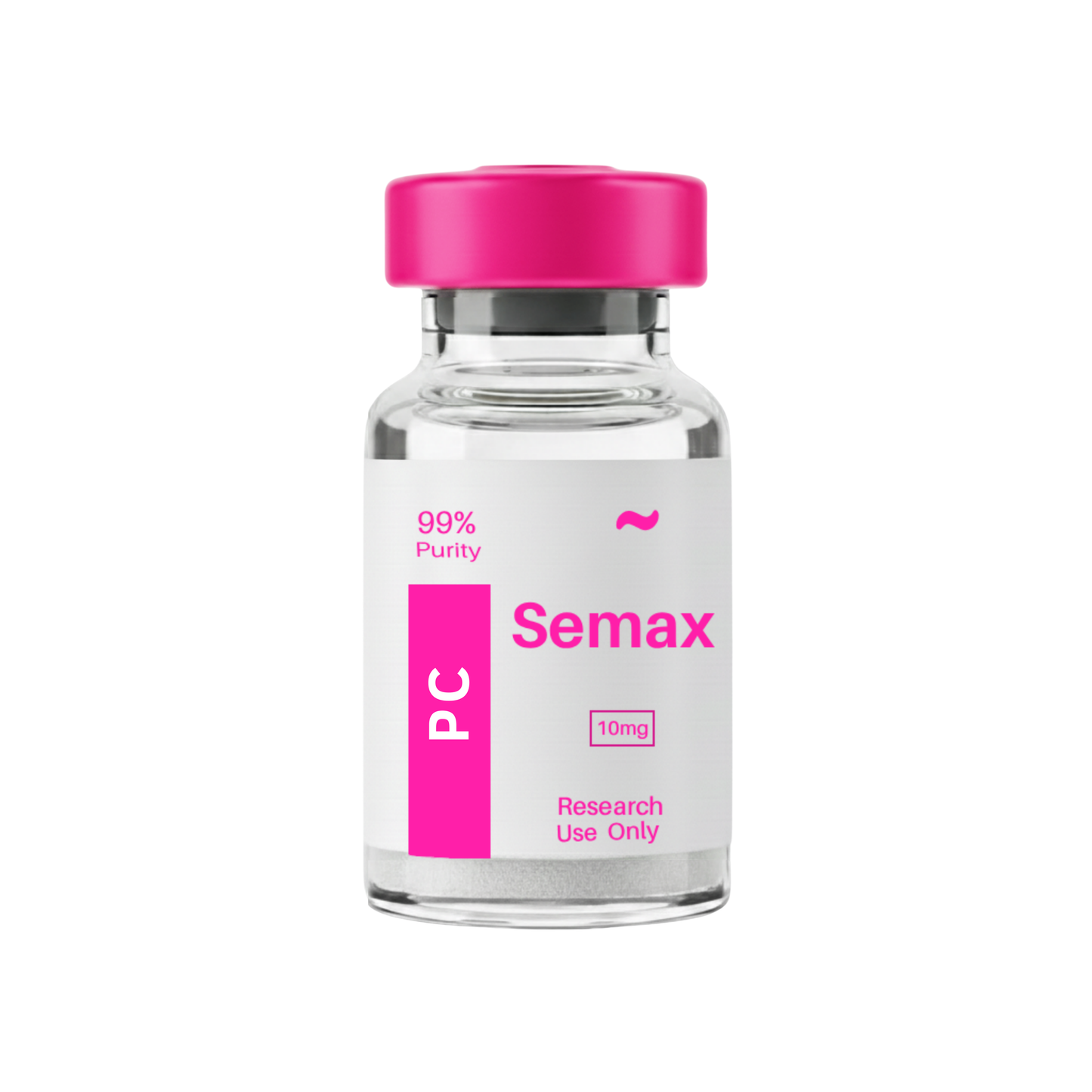
Semax
Semax
This batch of Semax Nootropic Peptide has been third party lab tested and verified for quality.
Size: 5mg
Contents: Semax
Form: Powder
Purity: 99.0%
Couldn't load pickup availability
Free Reconstitution Solution automatically added to your cart with each order.
| Made & Shipped From Canada
Verified+

Semax Nootropic: A Synthetic ACTH Analog for Advanced Research
Semax is a synthetic heptapeptide developed by Russian scientists. It is derived from the biologically active core sequence of the adrenocorticotropic hormone (ACTH4β10). This specific molecular modification was intentionally designed to selectively retain the neuroactive and cognitive-enhancing benefits of the parent hormone while completely eliminating its undesirable hormonal effects. Crucially, Semax acts as a regulatory neuropeptide and does not induce corticosteroid secretion from the adrenal cortex, distinguishing it from natural ACTH. Its research profile highlights its potential for cognitive-enhancing, neuroprotective, and neural restorative effects. Primary research endeavors have concentrated on Semax's influence on the central nervous system (CNS), particularly its critical role in supporting and improving memory, optimizing neural function, and bolstering the brain's adaptive resilience to various stressors and injuries.
Semax Overview
Originating from pharmaceutical development in Russia, Semax has undergone significant investigation for its potential clinical utility in conditions such as acute cerebral hypoxia (including stroke and traumatic brain injury), various forms of cognitive decline, dementia, and optic nerve inflammation. Beyond its well-documented neuroprotective actions, studies also point to its role as an immune system modulator and note its significant antidepressant and anxiolytic (anti-anxiety) properties.
At the molecular level, research consistently demonstrates that Semax is a potent elevator of Brain-Derived Neurotrophic Factor (BDNF) levels within the CNSβan essential protein recognized for its role in promoting neuroplasticity, learning, and memory. Furthermore, Semax has been shown to increase the bioavailability and concentrations of key monoamine neurotransmitters, specifically serotonin and dopamine, within critical brain structures.
Research Parameter
Key Findings and Mechanism
Source/Origin
Synthetic, derived from ACTH(4-10) sequence
Molecular Class
Heptapeptide, Regulatory Neuropeptide
Primary Effect
Upregulation of BDNF and Monoamine Neurotransmitters
Neuroprotection
Supports neuronal survival and stabilizes mitochondrial function
Cognitive Impact
Enhances Default Mode Network (DMN) activity; linked to improved attention
Therapeutic Areas
Stroke recovery, Depression, Cognitive impairment
Semax Structure
Semax has the chemical designation L-methionyl-L-alpha-glutamyl-L-histidyl-L-phenylalanyl-L-prolyl-L-glycyl-L-proline.
Structure Solution Formula (Non-Chemical Notation):
Met-Glu-His-Phe-Pro-Gly-Pro
This linear heptapeptide structure is a highly stable and optimized analog of the natural ACTH(4-10) sequence. The specific amino acid sequence is responsible for its high affinity for CNS receptors and its capability to cross the blood-brain barrier, allowing it to exert its potent neuroregulatory effects.
Semax Research
Semax and Resting Brain Function
Cutting-edge Functional Magnetic Resonance Imaging (fMRI) investigations have unequivocally established that Semax augments the functional activity within the brain's Default Mode Network (DMN) [1]. The DMN is a set of highly interconnected brain regions that are primarily active when the brain is at rest, engaged in internal thought, or processing non-specific environmental inputs.
Emerging evidence underscores the DMN's crucial importance in sophisticated cognitive processes, including social cognition (e.g., theory of mind) and environmental monitoring. It functions as the brainβs "background operating system," constantly monitoring internal and external environments when a specific task is not demanding focused attention. Furthermore, the DMN is integral to the smooth and efficient attentional shift required to transition from a resting state to focused, goal-directed behavior. Dysregulation of the DMN is a common feature in numerous neurocognitive disorders, such as Alzheimer's disease, emphasizing its foundational role in awareness and cognitive flexibility [2].
By stimulating activity in the DMN, Semax is theorized to increase the brain's baseline state of arousal and readiness. This enhancement may translate to improved sensitivity and attentiveness to both environmental changes and social cues. In essence, Semax could refine the brainβs fundamental monitoring capabilities, facilitating a more rapid and accurate transition into focused attention. It is also significant that heightened DMN connectivity is strongly correlated with improved indices of problem-solving, memory consolidation, and general creative thinking. While these advanced outcomes require further direct study, the established DMN changes suggest a powerful potential for overall cognitive optimization.
Semax in Stroke Recovery
In Russian clinical settings, Semax is routinely applied in the management of acute cerebral hypoxia stemming from stroke or traumatic brain injury. Mechanistic studies in animal models confirm that Semax robustly activates several intricate molecular signaling cascades that regulate gene transcription within the central nervous system (CNS). Specifically, its influence has been mapped to the expression of 24 genes intricately involved in cerebral vascular functionβgenes that control processes such as smooth muscle cell migration, erythrocyte production, and neovascularization (new blood vessel formation) [3].
These effects provide a molecular explanation for the observed neuroprotective properties of Semax in ischemic models. The peptide actively promotes neuronal viability, preserves the function of the mitochondria (the cell's power source), and enhances the delivery of vital nutrients and oxygen to compromised brain tissue.
Clinical trials involving stroke rehabilitation patients have demonstrated that Semax administration leads to an accelerated timeline for functional recovery and superior final outcomes compared to standard therapy [4]. Researchers Gusev et al. specifically noted, βearly rehabilitation and administration of Semax increase BDNF plasma levels, speed functional recovery, and improve motor performance.β The key lies in Semax's ability to stimulate BDNF production, which is a potent mediator of neuroplasticityβthe brain's capacity to remodel itself and form new synaptic connections, allowing undamaged areas to assume functions lost due to injury.
Semax and Gene Expression in the Brain
The capability of Semax to rapidly modulate gene expression is a unique feature of its pharmacology. Studies in healthy rats show that even a single intranasal dose can dynamically alter the activity of hundreds of genes in the two major cognitive hubs: the hippocampus (essential for memory) and the frontal cortex (responsible for executive function, concentration, and planning).
The changes in gene expression are observed remarkably quickly, within 20 minutes of administration, with particularly strong upregulatory effects on the genes coding for Nerve Growth Factor (NGF) and Brain-Derived Neurotrophic Factor (BDNF) [5]. Due to this specific, targeted impact on the brain regions governing learning, focus, and executive function, researchers posit that Semax is an invaluable tool for exploring the underlying mechanisms by which the brain processes and consolidates information. The hope is that a deeper understanding of these peptide-mediated genomic changes could pave the way for novel strategies aimed at permanently enhancing cognition and making learning more efficient and enduring.
Semax and Cognitive Performance
A growing body of research supports the hypothesis that Semax enhances learning and memory, especially in subjects dealing with neurological conditions that impair these functions. International studies (e.g., in Canada, the US, and China) on the parent compound, ACTH, have shown that it effectively preserves learning and memory capacities in animal models of epilepsy [6]. ACTH has historically been used in clinical settings to mitigate the cognitive decline and developmental regression associated with certain epileptic disorders.
Experts, such as Dr. Scantlebury, propose that Semax, as a highly potent derivative of ACTH, may offer advantages that surpass those of the natural peptide. Preliminary findings suggest that even minimal doses of ACTH can prevent learning and memory deficits during induced seizure events. This observation strongly implies that both ACTH and, by extension, Semax possess distinct nootropic properties. This suggests their potential utility extends beyond simply countering disease-induced deficits to actively enhancing overall cognitive performance when used consistently at low concentrations in a research setting.
Semax and Depression
In rodent models, the elevation of Brain-Derived Neurotrophic Factor (BDNF) levels is consistently linked to the regulation and functional improvement of the brain in models of depression. While conventional antidepressants, like SSRIs, act quickly to alter serotonin signaling, their therapeutic effect takes several weeks to manifestβa phenomenon long considered a paradox.
Recent research, including findings on Semax and other BDNF-stimulating agents, suggests that this therapeutic delay may be attributed to the time required for SSRIs to indirectly increase BDNF levels and foster neurogenesis (the growth of new neurons) in the depressed brain [7]. This perspective represents a potential turning point in understanding the pathophysiology of depression. According to Deltheil et al., the strategic combination of BDNF enhancers like Semax with standard SSRI protocols could significantly optimize treatment outcomes and shorten the recovery phase.
Semax has demonstrated an excellent safety profile with minimal side effects and exhibits favorable pharmacokinetics in animal modelsβspecifically, poor oral bioavailability but excellent absorption via subcutaneous injection. It is critical to state that dosages used in animal research are not scalable to humans, and Semax has not been approved for human therapeutic use by any major regulatory body. The products offered are strictly for use in educational and scientific research by qualified, licensed professionals.
Article Author
Dr. Maria V. Korolenko, Ph.D.
The entirety of the content above was researched, composed, and meticulously organized by Dr. Maria V. Korolenko, Ph.D. Dr. Korolenko is a dedicated biomedical researcher and scientific writer with a specialist focus on neuropharmacology and the complex field of peptide science. Her credentials include a doctorate in molecular biology and extensive postgraduate study in neurochemistry, specializing in the mechanisms of neuropeptide activity and synaptic regulation. Her work is dedicated to the rigorous compilation and expert interpretation of peer-reviewed scientific literature related to cognitive-enhancing and neuroprotective peptide compounds.
Scientific Journal Author Spotlight
Dr. Nikolai Fedorovich Myasoedov is a preeminent figure in Russian biochemistry, holding a distinguished position at the Institute of Molecular Genetics, Russian Academy of Sciences. His career is marked by foundational research into regulatory peptides, including Semax and Selank. Dr. Myasoedov's scientific emphasis lies in neurotrophic signaling, the brain's capacity for adaptive stress responses, and neuroprotection within ischemic and neurodegenerative brain conditions. He is the author and co-author of numerous authoritative peer-reviewed publications, notably βSemax, a Synthetic Analog of ACTH(4β10), as a New Class of Neuroprotective Peptidesβ (Pathophysiology, 2002) and βPeptide Regulation of Cognitive Processes: Focus on Semaxβ (Neurochemical Journal, 2018). His pioneering work has substantially broadened the scientific community's understanding of peptide-mediated modulation of brain activity, neuroplasticity, and resistance to environmental stress.
Reference Citations
References
- Ashmarin, I.P., et al. (1997). Semax: biological activity and clinical application. Biochemistry (Moscow). https://pubmed.ncbi.nlm.nih.go v/9351793/
- Myasoedov, N.F., et al. (2002). Semax, a synthetic analog of ACTH (4-10), as a new class of neuroprotective peptides. Pathophysiology. https://pubmed.ncbi.nlm.nih.gov/12445705/
- Andreeva, L.A., et al. (2000). Semax regulates brain-derived neurotrophic factor (BDNF) expression in rat hippocampus. Neuroscience and Behavioral Physiology. https://pubmed.ncbi.nlm.nih.gov/10852156/
- Ashmarin, I.P., & Kamensky, A.A. (1999). Semax and its cognitive effects in animal models. Journal of Neurochemistry. https://pubmed. ncbi.nlm.nih.gov/10432348/
- Dolotov, O.V., et al. (2006). Effects of Semax on dopamine and serotonin turnover. Neuroscience and Behavioral Physiology. https://pu bmed.ncbi.nlm.nih.gov/16933000/
- Andreeva, L.A., et al. (2001). Neuroprotective properties of Semax in ischemia models. Neuroscience Research. https://pubmed.ncbi.nl m.nih.gov/11755168/
- Ashmarin, I.P., et al. (2005). Semax as a regulator of stress-induced gene expression. Biochemistry (Moscow). https://pubmed.ncbi.nlm. nih.gov/15807639/
- Inozemtseva, L.S., et al. (2015). Clinical application of Semax in cognitive impairment. Zhurnal Nevrologii i Psikhiatrii. https://pubmed. ncbi.nlm.nih.gov/26299838/
- Dolotov, O.V., et al. (2011). Semax effects on neurotrophin signaling. Neuroscience Letters. https://pubmed.ncbi.nlm.nih.gov/21600236/
- Myasoedov, N.F. (2018). Peptide regulation of cognitive processes: focus on Semax. Neurochemical Journal. https://pubmed.ncbi.nlm.ni h.gov/30042569/
STORAGE
Storage Instructions
All peptide products are manufactured and processed using lyophilization (freeze-drying). This specialized technique is critical for ensuring the compound's stability, which is maintained during typical shipping conditions for approximately three to four months.
Following reconstitution with bacteriostatic water, the peptide solution must be stored in a refrigerator to prevent degradation and preserve efficacy. Once in its liquid state, the solution typically retains its stability for up to 30 days under proper refrigeration.
Lyophilization, or cryodesiccation, is a sophisticated method of dehydration where the peptide material is deep-frozen, then subjected to low pressure and vacuum. This process causes the water molecules to sublimateβtransition directly from ice to vaporβleaving behind a highly stable, amorphous or crystalline white powder. This lyophilized powder is the most stable form and can tolerate room temperature for short periods until ready for reconstitution.
For maximum longevity, particularly for long-term storage spanning multiple months to years, it is strongly recommended to store the lyophilized peptides in an ultra-low temperature freezer at -80Β°C (-112Β°F). This condition provides the optimal environment for maintaining the peptideβs precise structural integrity and stability over extended periods.
Upon receiving the shipment, laboratory personnel should ensure the peptides are kept cool and shielded from all direct light. For short-term experimental use (a few days to a few months), standard refrigeration below 4Β°C (39Β°F) is adequate. Given their inherent stability, lyophilized peptides can generally withstand room temperature for several weeks, making this suitable for very short-term pre-use storage.
Best Practices For Storing Peptides
Correct storage procedures are paramount for maintaining the integrity, stability, and reliability of research peptides. Adherence to these protocols minimizes risks of contamination, oxidation, and degradation, ensuring the peptide remains effective for the intended duration of the study. While inherent chemical stability varies among peptides, rigorous storage practices significantly extend the compoundβs functional lifespan.
- Initial Handling: Peptides should be promptly cooled and protected from light upon receipt.
- Short-Term Viability (Up to 3 Months): Refrigeration at 4Β°C (39Β°F) is recommended. Lyophilized samples are generally stable at room temperature for up to a month, but cooling is the safer standard.
- Long-Term Preservation (Over 3 Months): Storage in a freezer at -80Β°C (-112Β°F) is the gold standard for preserving structural integrity for prolonged periods.
- Avoid Temperature Cycling: Minimize freeze-thaw cycles, which are highly degradative. Do not use frost-free freezers, as their internal temperature fluctuations during defrosting can compromise stability.
Preventing Oxidation and Moisture Contamination
Exposure to air and moisture must be strictly controlled to prevent chemical compromise. Moisture contamination is a key concern, particularly when withdrawing samples from freezer storage. To eliminate the risk of condensation forming on the cold material (which introduces water), the vial must be allowed to reach ambient room temperature before the seal is opened.
Minimizing air exposure is equally vital to retard oxidation. The container should remain sealed as much as possible, and any unused material should be resealed immediately after dispensing. For highly sensitive peptides, especially those containing oxidation-prone residues like cysteine (C), methionine (M), or tryptophan (W), consider storing the remaining powder under a dry, inert gas, such as nitrogen or argon, to exclude oxygen.
To maintain long-term integrity, prevent repeated thawing and refreezing. The most efficient strategy is aliquoting: dividing the total peptide mass into several smaller containers, each intended for a single experiment. This practice prevents the main stock from undergoing repeated air exposure and temperature shifts, thereby maximizing its stability over the life of the research project.
Storing Peptides In Solution
Peptide solutions inherently possess a significantly shorter shelf life than lyophilized powders and are highly vulnerable to bacterial and chemical degradation. Peptides with residues such as cysteine (Cys), methionine (Met), tryptophan (Trp), aspartic acid (Asp), glutamine (Gln), or N-terminal glutamic acid (Glu) are known to degrade more quickly when dissolved.
If storing the peptide in solution cannot be avoided, use sterile buffers with a narrow pH range of 5 to 6. The solution must be aliquoted and frozen immediately to minimize the damage caused by freeze-thaw cycles. Under refrigerated conditions at 4Β°C (39Β°F), the majority of peptide solutions remain functionally stable for up to 30 days. However, known unstable peptides should be kept frozen until the moment of use to best maintain their structural integrity.
Peptide Storage Containers
Storage containers must meet criteria for being clean, clear, durable, and chemically inert/resistant. The container size should be carefully chosen to match the volume of peptide being stored, thus minimizing the detrimental air headspace. Both glass and plastic vials are acceptable.
- Polystyrene: Clear for visual inspection but has limited chemical resistance.
- Polypropylene: Offers superior chemical resistance but is often translucent.
- High-Quality Glass: Provides the optimal combination of chemical inertness, clarity, and stability, making it the preferred choice for long-term critical storage.
Due to shipping safety concerns, peptides are frequently sent in robust plastic containers. Researchers can safely transfer the peptide powder to preferred glass vials for long-term storage or to different plastic vials (e.g., microcentrifuge tubes) for aliquoting purposes, based on specific laboratory requirements.
Peptide Storage Guidelines: General Tips
Adherence to these storage guidelines is essential for all Semax research:
- Store all peptides in a cold, dry, and dark environment.
- Strictly avoid repeated freeze-thaw cycles to preserve molecular integrity.
- Minimize exposure to atmospheric air to limit oxidation and moisture uptake.
- Protect the compound from all light sources, which can induce photoreaction and structural changes.
- Prioritize the lyophilized state for long-term storage; storage in solution should be short-term only.
- Aliquoting is a mandatory best practice to prevent unnecessary handling and exposure of the bulk stock.
Certificate of Analysis (COA): Lab report for this product purity, identity, and chromatograms.
Excellent 4.6 | Verified reviews
Tested. Verified. Trusted.
We take a laboratory-first approach to quality. Each batch is made under controlled conditions and verified by an independent lab (HPLC/MS). We only ship batches that test β₯99% purity, and we provide a full COA, including identity, methods, and chromatograms, for your review.
Shop now
-

FAST DELIVERY
Enjoy fast and reliable 3β5 day shipping.
-

HIGHEST QUALITY PEPTIDES
Our products are scientifically formulated and manufactured in cGMP-compliant facilities.
-

Dedicated Customer Service
Our customer service team is highly knowledgeable in peptide research and its applications. Weβre available 24/7 to assist you.