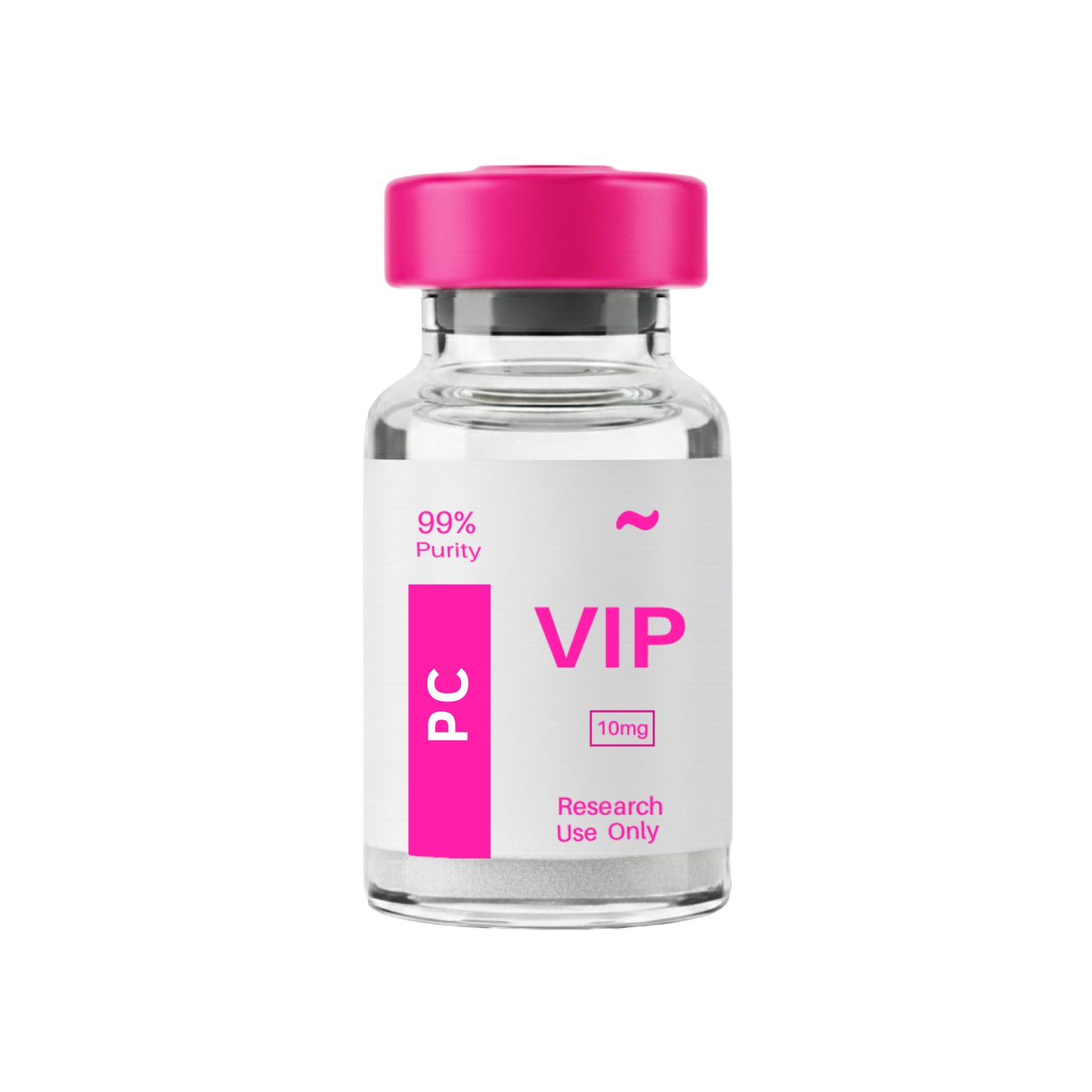
VIP
VIP
This batch of VIP (Vasoactive Intestinal Peptide) has been third party lab tested and verified for quality.
Size: 10mg
Contents: Vasoactive Intestinal Peptide
Form: Powder
Purity: 99.44%
Couldn't load pickup availability
Free Reconstitution Solution automatically added to your cart with each order.
This product is Made, Tested & Shipped From Canada.
Ships Today
Order by 1:00 PM EST
Free Shipping
For 2 or more vials
Verified+

Vasoactive Intestinal Peptide (VIP)
Vasoactive Intestinal Peptide (VIP), also referred to as vasoactive intestinal polypeptide, is a naturally occurring 28-amino acid neuropeptide that functions as both a hormone and a neuromodulator. It is synthesized in the central nervous system, enteric nervous system, and pancreas, exerting its effects across a broad spectrum of tissues in humans and other vertebrates. VIP signals through the Class II G protein-coupled receptors (GPCRs), primarily VPAC1 and VPAC2, which are integral to its diverse physiological activities.
Key biological roles of VIP include:
- Vasodilation and Blood Pressure: Potently reduces systemic blood pressure by acting as a strong vasodilator.
- Cardiovascular Function: Enhances cardiac performance by increasing both heart rate and contractile strength (positive chronotropic and inotropic effects).
- Gastrointestinal Regulation: Induces smooth muscle relaxation throughout the alimentary canal and stimulates fluid and electrolyte secretion.
- Metabolism: Promotes the breakdown of stored glycogen (glycogenolysis) in hepatic and muscular tissues.
- Neuroprotection and Circadian Rhythm: Supports the integrity of the blood-brain barrier (BBB), shields neurons from injury (neuroprotection), and helps regulate the body's circadian clock via the suprachiasmatic nucleus (SCN).
- Immunomodulation: Exhibits significant anti-inflammatory and anti-fibrotic activities, which are currently a major focus of research.
The profound and multifaceted nature of VIP's influence on inflammation and tissue repair has cemented its status as a peptide of intense scientific interest.
Vasoactive Intestinal Peptide (VIP) 10mg Overview
Vasoactive Intestinal Peptide (VIP) is a potent neuroendocrine peptide that mediates its effects through the high-affinity VPAC1 and VPAC2 receptors. Upon binding, VIP activates these G protein-coupled receptors, leading to an intracellular increase in cyclic adenosine monophosphate (cAMP). This cAMP signaling cascade is the fundamental mechanism behind VIP's capacity to induce smooth muscle relaxation and subsequently improve regional blood flow.
Research models have extensively explored VIP's potential as an immunoregulator. It has been shown to modulate immune signaling by actively suppressing the production of harmful pro-inflammatory cytokines. Its tissue-protective roles are being studied in contexts ranging from pulmonary fibrosis and inflammatory bowel diseases to chronic neurodegenerative conditions. Beyond its immunomodulatory effects, VIP also critically influences vital physiological processes such as gastrointestinal motility, endocrine secretion, and the central regulation of daily rhythms.
Vasoactive Intestinal Peptide (VIP) Structure
Vasoactive Intestinal Peptide (VIP) is a 28-amino acid polypeptide characterized by its membership in the secretin/glucagon peptide family. The conserved structure, including an amidated C-terminus, is crucial for its biological receptor affinity and function.
The amino acid sequence for human/porcine/bovine Vasoactive Intestinal Peptide is:
H-His-Ser-Asp-Ala-Val-Phe-Thr-Asp-Asn-Tyr-Thr-Arg-Leu-Arg-Lys-Gln-Met-Ala-Val-Lys-Lys-Tyr-Leu-Asn-Ser-Ile-Leu-Asn-NH2
The molecular formula for VIP is: C130H215N43O37S
The approximate molecular weight is 3325.82 g/mol.
Vasoactive Intestinal Peptide (VIP) Research
VIP's diverse origins, including production by both specialized nerve fibers and immune cells, highlight its dual role in the neuro-immune axis. Its ability to shift immune responses toward the Th2 phenotype (which typically suppresses pro-inflammatory Th1 activity) has made it a central focus in research concerning chronic inflammatory and fibrotic conditions.
Intestinal Barrier and Inflammation
In experimental models of Inflammatory Bowel Diseases (IBDs) (Crohn’s disease, ulcerative colitis), VIP demonstrates two critical actions:
- Anti-inflammatory Cytokine Induction: VIP stimulates T cells to produce the anti-inflammatory cytokine interleukin-10 (IL-10), effectively dampening the Th1-driven inflammation characteristic of IBD.
- Epithelial Barrier Support: VIP enhances the integrity of the intestinal epithelial barrier. Barrier dysfunction is a key element in IBD pathogenesis, allowing excessive antigen exposure to the underlying immune tissue. By reinforcing this barrier, VIP can limit the initiation of the inflammatory cascade.
Pulmonary Protection and Airway Remodeling
VIP influences lung function through mechanisms that target inflammation and tissue remodeling:
- NFAT Suppression and Fibrosis: VIP has been shown to modulate the inflammatory environment by suppressing the NFAT peptide, which typically promotes T cell activation. This mechanism is critical in preventing pulmonary fibrosis, the severe scarring associated with end-stage inflammatory lung diseases like COPD and sarcoidosis.
- Inhibition of Smooth Muscle Growth: VIP directly inhibits the proliferation of smooth muscle cells in lung tissue. This action is significant for conditions like chronic asthma, where excessive smooth muscle growth contributes to irreversible airway remodeling.
Immunomodulation in Organ Transplantation
The challenge of immune-mediated rejection in organ transplantation is a key area of VIP research. VIP acts on Dendritic Cells (DCs), which are crucial antigen-presenting cells that initiate immune rejection.
- Tolerance Induction: VIP reduces the proliferation and activation of DCs, effectively preventing the full initiation of the immune response. Importantly, VIP appears to selectively favor DCs associated with tolerogenic antigens, helping to steer the immune system toward acceptance rather than rejection of the transplanted tissue. This suggests VIP could form the basis of a new, targeted approach to anti-rejection therapy with potentially fewer risks of broad-spectrum immunosuppression.
Neuroprotection and Central Nervous System (CNS) Function
Within the CNS, VIP serves as a versatile neuroagent:
- Blood-Brain Barrier (BBB) Support: It is vital for maintaining the integrity of the BBB, which is often compromised in neurological disorders like multiple sclerosis and stroke.
- Mitigation of Neurodegeneration: Research indicates VIP can modulate the accumulation of beta-amyloid in Alzheimer’s models and exhibits direct anti-inflammatory effects in Parkinson’s disease by promoting the shift to an anti-inflammatory Th2 response. VIP also protects against excitotoxic white matter damage and supports neuronal myelination.
Regression of Cardiac Fibrosis
Cardiac fibrosis, the progressive scarring of heart tissue, leads to terminal complications in heart disease. VIP research offers a unique perspective:
- Anti-Fibrotic Signaling: Animal studies suggest VIP may not only inhibit the progression of scar formation but also promote the regression of existing fibrotic tissue. This effect is linked to a notable reduction in the expression of angiotensinogen and angiotensin receptor type 1a—pathways central to cardiac remodeling and consistent with the established mechanism of ARB and ACE inhibitor drugs.
VIP and COVID-19 Research
The synthetic VIP analogue, aviptadil (RLF-100), has been researched for its potential to treat severe respiratory distress in COVID-19. Aviptadil's mechanism involves powerful anti-inflammatory action by suppressing pro-inflammatory cytokine storms. Crucially, it has been observed to protect the type II alveolar cells (vital for oxygen exchange) and may interfere with the SARS-CoV-2 virus's ability to infect these cells. Clinical trials have investigated aviptadil's efficacy in preventing severe respiratory complications.
Vasoactiv Intestinal Peptide (VIP) Key Research Areas
Research Focus
Physiological Role/Target
Key Mechanism of Action
Immunomodulation
Systemic Inflammation, IBD
Suppresses pro-inflammatory cytokines; promotes IL-10 (anti-inflammatory) production; shifts Th1/Th2 balance.
Anti-Fibrotic Potential
Pulmonary and Cardiac Fibrosis
Suppresses NFAT activity; reduces angiotensin receptor expression; potential scar regression.
Neuroprotection
Alzheimer's, Parkinson's, Stroke
Maintains Blood-Brain Barrier (BBB) integrity; modulates beta-amyloid accumulation; reduces excitotoxic damage.
Transplantation Medicine
Allograft Rejection
Modulates Dendritic Cell (DC) activity; promotes immune tolerance.
Airway Regulation
Asthma, COPD
Inhibits pulmonary smooth muscle cell proliferation; reduces airway remodeling.
Storage and Handling
Maintaining the integrity of Vasoactive Intestinal Peptide (VIP) is essential for accurate research outcomes. The peptide is highly stable in its lyophilized form but requires specific conditions to prevent degradation.
Storage Instructions
The product is provided in a lyophilized (freeze-dried) state, a process that ensures stability and efficacy during transport. The lyophilized powder is a stable, crystalline solid.
- Short-Term Storage (Days to Months): Store the lyophilized peptide in a refrigerator below 4°C (39°F). Lyophilized VIP is generally stable at room temperature for several weeks, but refrigeration is the best practice for short to medium duration.
- Long-Term Storage (Months to Years): For optimal preservation over extended periods, store the lyophilized peptide in a freezer at -80°C (-112°F). This condition minimizes the risk of structural degradation and maximizes the product's shelf life.
- Post-Reconstitution: Once reconstituted with bacteriostatic water, the peptide solution should be refrigerated below 4°C (39°F) and is typically stable for up to 30 days.
Best Practices For Storing Peptides
- Aliquot to Prevent Degradation: To minimize the damaging effects of repeated freeze-thaw cycles and frequent air exposure, it is highly recommended to aliquot the peptide (both lyophilized and in solution) into smaller, single-use portions immediately upon receipt.
- Avoid Frost-Free Freezers: Temperature fluctuations inherent in defrosting cycles can compromise peptide stability. Use a static, laboratory-grade freezer for long-term frozen storage.
- Protection from Light: Peptides should always be stored in a dark environment to prevent light-induced structural changes.
Preventing Oxidation and Moisture Contamination
Exposure to moisture and air can severely compromise peptide stability, particularly through oxidation.
- Temperature Acclimation: To avoid condensation forming on the cold peptide, which introduces moisture, always allow the vial to reach room temperature inside a desiccator or closed container before opening it after removal from the freezer.
- Air Exposure Minimization: Keep the container closed as much as possible. For maximum protection against oxidation, especially for peptides containing sensitive residues (Cysteine, Methionine, Tryptophan), the remaining lyophilized product should be stored under an inert gas atmosphere (e.g., argon or nitrogen) and tightly sealed.
Storing Peptides In Solution
Peptides in solution are significantly more susceptible to degradation and have a shorter half-life than the lyophilized form.
- Buffer Selection: If solution storage is unavoidable, use sterile buffers with a mild, slightly acidic pH range of 5 to 6.
- Freezing: Freezing aliquoted solutions at -20°C or -80°C is required for extended storage beyond 30 days.
Reference Citations
Said SI, Mutt V. Polypeptide with broad biological activity: isolation from small intestine. Science. 1970;169(3951):1217–1218.
Laburthe M, Couvineau A. Molecular pharmacology and structure of VPAC receptors for VIP and PACAP. Regul Pept. 2002;108(2-3):165-173.
Ganea D, Delgado M. The neuropeptides VIP/PACAP and T cells: inhibitors or activators? Curr Pharm Des. 2003;9(12):997-1004.
Harmar AJ, et al. Pharmacology and functions of receptors for VIP and PACAP. Br J Pharmacol. 2012;166(1):4-17.
Vaudry D, et al. Pituitary adenylate cyclase-activating polypeptide and VIP: neuroprotective peptides. Trends Neurosci. 2009;32(12):728-735.
Delgado M, et al. Vasoactive intestinal peptide and the immune system. Endocr Rev. 2004;25(5): 649-685.
Said SI. Vasoactive intestinal peptide in the lung. Ann NY Acad Sci. 1991;629:158-172.
Groneberg DA, et al. Role of VIP in airway smooth muscle function. Eur J Pharmacol. 2001;424(1):21-29.
Gozes I, et al. Neuroprotective peptide activity of VIP and derivatives. J Mol Neurosci. 2003;20(3):273-285.
Martinez C, et al. VIP and immune tolerance in inflammatory bowel disease models. Gut. 1999;45(5): 672-678.
-

HIGHEST QUALITY PEPTIDES
Our products are scientifically formulated and manufactured in cGMP-compliant facilities.
-

FAST DELIVERY
Enjoy fast and reliable 3–5 day shipping.
-

Dedicated Customer Service
Our customer service team is highly knowledgeable in peptide research and its applications. We’re available 24/7 to assist you.
Verified reviews
Tested. Verified. Trusted.
We take a laboratory-first approach to quality. Each batch is made under controlled conditions and verified by an independent lab (HPLC/MS). We only ship batches that test ≥99% purity, and we provide a full COA, including identity, methods, and chromatograms, for your review.
Shop now
See the Process for Yourself
We make our peptides in our own cGMP lab. Watch the video to see how every vial is produced, tested, and handled with care.
You may also like
-
SAVE 25%Reconstitution Solution
Regular price $15.00Regular price $15.00 Sale priceUnit price / per$20.0025% -
BPC-157 + TB-500 + GHK-Cu Peptide Blend - Research Grade Peptide Compound
Regular price $139.00Regular price $139.00 Sale priceUnit price / per$181.0023% -
Glow BPC-157 + GHK-CU + TB-500 - Premium Research Peptide
Regular price $139.00Regular price $139.00 Sale priceUnit price / per$181.0023% -
SAVE 25%Tirzepatide
Regular price From $50.00Regular price From $50.00 Sale priceUnit price / per$67.0025% -
Thymosin Alpha-1 - Premium Research Peptide
Regular price From $79.00Regular price From $79.00 Sale priceUnit price / per$104.0024% -
SAVE 23%Tesamorelin
Regular price From $75.00Regular price From $75.00 Sale priceUnit price / per$98.0023% -
SAVE 23%Survodutide
Regular price From $299.00Regular price From $299.00 Sale priceUnit price / per$392.0023% -
SAVE 23%Sterile Water
Regular price From $13.00Regular price From $13.00 Sale priceUnit price / per$17.0023% -
SAVE 23%SLU-PP-332
Regular price From $113.00Regular price From $113.00 Sale priceUnit price / per$148.0023% -
SAVE 25%Sermorelin
Regular price From $63.00Regular price From $63.00 Sale priceUnit price / per$84.0025% -
SAVE 27%Semaglutide
Regular price From $32.00Regular price From $32.00 Sale priceUnit price / per$44.0027% -
SAVE 26%Oxytocin Acetate
Regular price From $38.00Regular price From $38.00 Sale priceUnit price / per$52.0026% -
SAVE 24%LL-37 - Premium Research Peptide
Regular price $85.00Regular price $85.00 Sale priceUnit price / per$112.0024% -
SAVE 23%Lipo-C with B Vitamins
Regular price From $73.00Regular price From $73.00 Sale priceUnit price / per$96.0023% -
SAVE 23%Lemon Bottle 10mg
Regular price From $75.00Regular price From $75.00 Sale priceUnit price / per$98.0023% -
SAVE 23%L-Carnitine
Regular price From $97.00Regular price From $97.00 Sale priceUnit price / per$127.0023% -
KPV Tripeptide - Premium Research Peptide
Regular price From $56.00Regular price From $56.00 Sale priceUnit price / per$74.0024% -
KLOW Blend - GHK-CU + TB-500 + BPC-157 + KPV 10mg
Regular price From $188.00Regular price From $188.00 Sale priceUnit price / per$246.0023% -
SAVE 25%Kisspeptin-10
Regular price From $63.00Regular price From $63.00 Sale priceUnit price / per$85.0025% -
SAVE 25%Ipamorelin
Regular price From $27.00Regular price From $27.00 Sale priceUnit price / per$36.0025% -
SAVE 26%Hyaluronic Acid
Regular price From $25.00Regular price From $25.00 Sale priceUnit price / per$34.0026% -
SAVE 23%HGH Fragment 176-191
Regular price From $87.00Regular price From $87.00 Sale priceUnit price / per$114.0023% -
SAVE 25%HGH 191AA (Somatropin)
Regular price From $50.00Regular price From $50.00 Sale priceUnit price / per$67.0025% -
SAVE 25%Gonadorelin
Regular price $50.00Regular price $50.00 Sale priceUnit price / per$67.0025% -
Glutathione - Premium Research Peptide
Regular price $83.00Regular price $83.00 Sale priceUnit price / per$109.0023% -
Glow BPC-157 + GHK-CU + TB-500 - Premium Research Peptide
Regular price $139.00Regular price $139.00 Sale priceUnit price / per$181.0023% -
SAVE 26%Epitalon (Epithalon)
Regular price From $28.00Regular price From $28.00 Sale priceUnit price / per$38.0026% -
SAVE 25%Dermorphin
Regular price From $50.00Regular price From $50.00 Sale priceUnit price / per$67.0025% -
SAVE 24%CJC-1295 with DAC
Regular price From $69.39Regular price From $69.39 Sale priceUnit price / per$92.0024% -
SAVE 23%CJC-1295 No DAC & Ipamorelin
Regular price From $90.30Regular price From $90.30 Sale priceUnit price / per$118.0023% -
SAVE 23%CJC-1295 (No DAC)
Regular price From $75.00Regular price From $75.00 Sale priceUnit price / per$98.0023%
Every vial we sell comes from a lab that follows current Good Manufacturing Practices (cGMP). That means each step of production is documented and controlled. Before a batch is released, it’s tested by independent third-party labs for purity, identity, and sterility. Certificates of analysis are available so you can see the exact test results.
Yes. The labs we work with use ISO-certified clean rooms where air quality, equipment, and handling procedures are tightly regulated. Staff are trained to pharmaceutical-grade standards. This ensures the peptides are produced in an environment that minimizes contamination risks.
Peptides in lyophilized (freeze-dried) form are stable at room temperature for transport. Once you receive them, refrigeration is recommended to maintain long-term integrity. We package every order securely to prevent damage and ship promptly, so your vials arrive in optimal condition.
We operate under strict in-house protocols that follow current Good Manufacturing Practices (cGMP). That means our team oversees the entire process from sourcing raw amino acids to the final lyophilized vial. Nothing is outsourced or repackaged. This gives us full control over purity, consistency, and sterility, and it’s why we can stand behind every single vial we ship.
Store them in the refrigerator, away from direct light and heat. If you need to keep them longer, some peptides can be stored frozen. Each vial comes with clear handling instructions so you know the proper conditions for stability.
The strongest proof is transparency. For every peptide, we can provide certificates of analysis, manufacturing documentation, and references to the published scientific research behind it. If you ever have questions, we’ll show you the data rather than ask you to take our word for it.
The difference is transparency. Most sites give you a product name and a price. We provide full batch testing, lab documentation, and direct access to certificates of analysis so you don’t have to guess what you’re getting. When you order from us, you know exactly what’s in the vial, where it was made, and how it was verified.