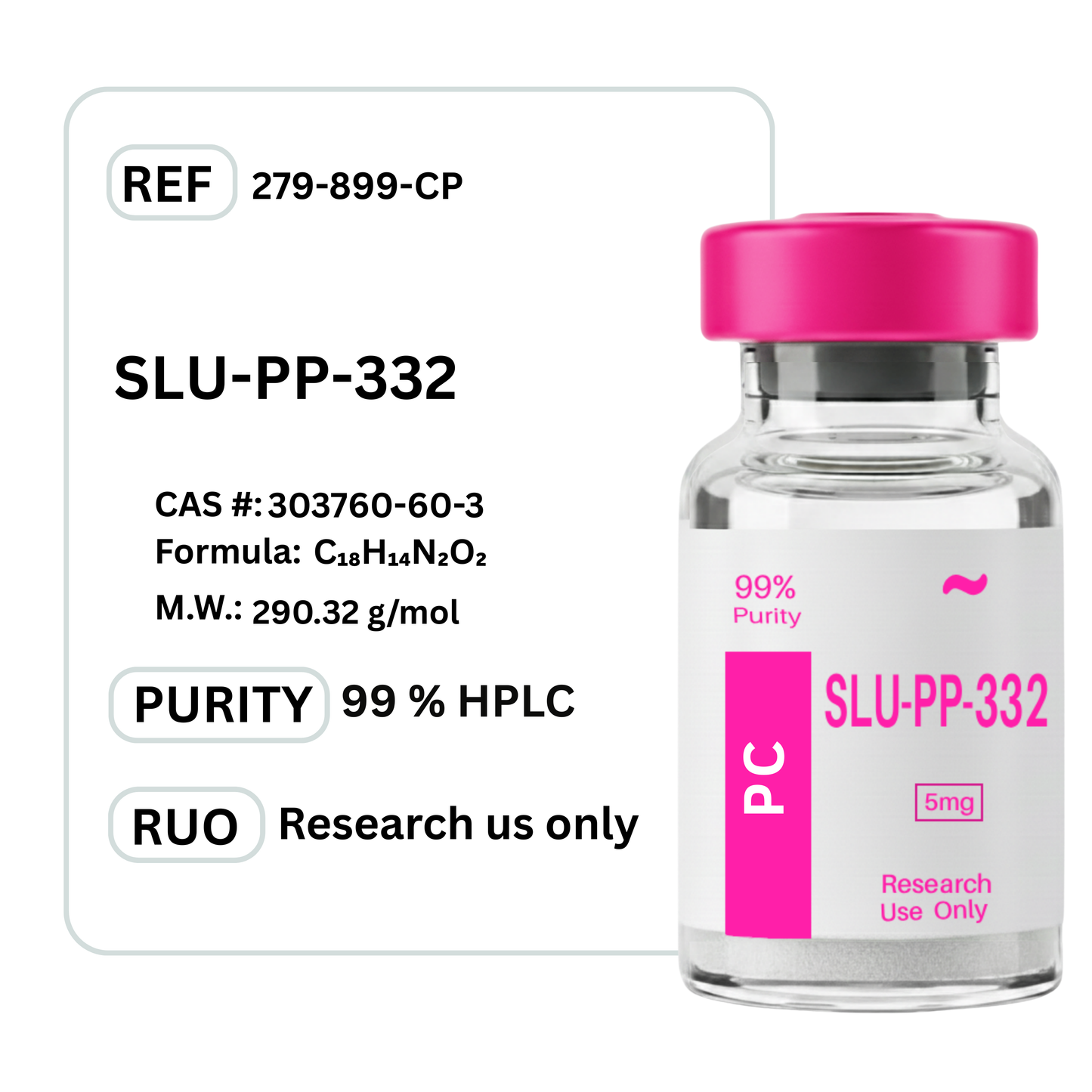
SLU-PP-332
SLU-PP-332
This batch of SLU-PP-332 Peptide has been third party lab tested and verified for quality.
Size: 5mg
Contents: SLU-PP-332 (PPARδ/PPARα Modulator)
Form: Powder
Purity: 99.3%
Couldn't load pickup availability
Free Reconstitution Solution automatically added to your cart with each order.
This product is Made, Tested & Shipped From Canada.
Ships Today
Order by 1:00 PM EST
Free Shipping
For 2 or more vials
Verified+

SLU-PP-332 5mg
SLU-PP-332 is a novel chemical entity classified as an estrogen-related receptor (ERR) agonist. ERRs are integral components of the body's machinery for regulating energy utilization and metabolic fitness. In preclinical models, SLU-PP-332 demonstrates the functionality of an exercise mimetic, showcasing three primary effects:
- Augmented Lipid Oxidation: Significantly raises the body's overall energy expenditure, mainly by improving the efficiency of fat metabolism (fatty acid oxidation).
- Elevated Physical Capacity: Provides a measurable increase in physical endurance and exercise capacity.
- Mitochondrial Enhancement: Promotes mitochondrial biogenesis—the creation of new mitochondria—and improves the function of existing ones, which fundamentally enhances muscle performance and cellular energy supply.
SLU-PP-332 Overview
The broad and deep health advantages conferred by consistent physical activity are universally recognized, encompassing the prevention of cardiometabolic diseases, cognitive protection, and mood elevation. Despite decades of effort, success in developing pharmaceutical agents that genuinely replicate this comprehensive spectrum of benefits has been limited. The advent of SLU-PP-332 marks a significant turn, as this compound has demonstrated the ability to induce several key physiological adaptations of exercise.
SLU-PP-332 is a powerful, non-peptide small molecule that functions as an estrogen-related receptor (ERR) agonist, preferentially activating the alpha and gamma subclasses (ERRalpha and ERRgamma). Preclinical research suggests that SLU-PP-332 offers multifaceted metabolic and functional support: it boosts skeletal muscle endurance, assists in promoting weight loss through increased fat catabolism, aids in improving cardiovascular parameters, and provides evidence of neuroprotective effects against decline associated with aging and disease. This compound represents a critical step forward in the scientific quest to provide the cellular benefits of exercise without the requirement of physical exertion, generating widespread interest in the biomedical research community.
SLU-PP-332 Structure
The highly selective biological activity and enhanced bioavailability of SLU-PP-332, which enables its use in in vivo (whole organism) studies, are directly linked to its precise molecular structure.
Estrogen-related receptors (ERRs) are a subclass of orphan nuclear receptors. Despite the historical basis for their name—stemming from the genetic homology between ERRalpha and the estrogen receptor—ERRs are emphatically not regulated by estrogen; current data confirms a complete lack of influence by estrogen on ERR activity.
Functionally, ERRs act as crucial transcriptional regulators, controlling genes involved in essential processes such as energy balance, oxidative metabolism, and mitochondrial biogenesis. The three main subtypes—alpha, beta, and gamma—each contribute distinct elements to metabolic control:
ERR Subtype
Primary Function/Role
Key Tissues/Systems
ERRalpha
Master regulator of fasting and stress responses, controlling fatty acid oxidation, gluconeogenesis, and thermogenesis.
Heart, Skeletal Muscle, Liver, Brown Adipose Tissue
ERRgamma
Critical for maintaining mitochondrial homeostasis, high-energy demand organ function, and neuronal metabolism.
Muscle, Heart, Brain, Kidney
ERRbeta
Primarily involved in cell fate determination, mediating the transition of pluripotent stem cells and contributing to tissue repair and development.
Early Development, Stem Cells, Specific Tissues
When activated, ERRs—specifically ERRalpha and ERRgamma—stimulate the body's shift toward increased energy expenditure and significantly higher rates of fatty acid oxidation, which supports lipolysis (fat loss). Their regulatory role in mitochondrial function improves the performance of highly metabolic organs, notably the heart and skeletal muscle, leading to better physical capacity and cardiovascular health.
Structure Solution Formula (Plain Text)
Chemical Formula: C25H27F3N2O4S. Molecular Weight: 520.56 g/mol. SLU-PP-332 is an organic, non-peptide small molecule agonist.
SLU-PP-332 Research
SLU-PP-332: Mechanism as an Exercise Mimetic
SLU-PP-332's breakthrough lies in its capacity to drive improvements in cellular respiration, the core biological process that generates energy (ATP) in the mitochondria.
- Core Metabolic Enhancement: Exercise naturally increases both the sheer number and the operational efficiency of mitochondria. SLU-PP-332 mirrors these fundamental mitochondrial adaptations. This enhancement translates to systemic benefits, including a higher basal metabolic rate, improved glucose tolerance, reduced insulin resistance, and increased overall stamina and well-being.
- High In Vivo Efficacy: The design of SLU-PP-332 ensures excellent bioavailability after administration, enabling it to reach and activate ERRs throughout the body. This characteristic is crucial for its utility in in vivo research—studies within living organisms—distinguishing it from previous ERR agonists that were metabolically unstable or limited to in vitro (cell culture) applications.
- Unique ERRalpha Agonist: SLU-PP-332 is a significant scientific achievement because it is one of the first functional ERRalpha agonists. Given the established role of ERRalpha as a key metabolic sensor and regulator, this compound provides researchers with an unprecedented tool to investigate pathways related to physical conditioning and metabolic disease.
SLU-PP-332 and Endurance Enhancement
In studies measuring physical performance in non-obese mouse models, SLU-PP-332 demonstrated powerful ergogenic effects. Treated animals were able to sustain running for 70% longer in time and cover 45% greater distance than control subjects.
- Sustained Aerobic Output: This dramatic increase in endurance is directly linked to enhanced cellular energy production, which allows muscle tissue to maintain aerobic metabolism and resist fatigue for substantially longer periods.
- Fat as Fuel Source: The increased energy demand is met by a metabolic preference for fat oxidation, leading to more efficient fat burning and improved metabolic flexibility crucial for prolonged physical activity.
- Improved Tissue Perfusion: Activation of ERRgamma also mediates angiogenesis, promoting increased vascular density in skeletal muscle. This improved blood supply optimizes the delivery of oxygen and nutrients while simultaneously enhancing the clearance of metabolic waste products, thereby supporting greater physical performance and improved insulin sensitivity.
SLU-PP-332 and Muscle Function
The natural response of skeletal muscle to physical stress, such as intense exercise, is to increase ERR expression to improve energy utilization and oxygen efficiency. SLU-PP-332 mimics this natural adaptive signal, stimulating ERR expression in muscle tissue even without external physical demand. This molecular action results in enhanced mitochondrial function, superior energy production, and measurable improvements in skeletal muscle performance and endurance.
SLU-PP-332 and Heart Health
SLU-PP-332 acts as a pan-ERR agonist, activating all three receptor subtypes. In mouse models of induced cardiac failure, the compound exhibited comprehensive protective and restorative capabilities:
- Enhanced Contractility: Improved the heart's pumping efficiency, indicated by an improved ejection fraction.
- Reduced Scarring: Significantly reduced cardiac fibrosis, the harmful formation of non-functional scar tissue that impairs muscle contraction and conduction.
- Increased Survival: Led to increased survival rates in models of pressure overload-induced heart failure.
By supporting the heart's efforts to normalize fatty acid oxidation and restore energy homeostasis, SLU-PP-332 shows strong potential for research into cardiovascular health and recovery from cardiac injury.
SLU-PP-332 and Neuroprotection (Parkinson’s Disease Research)
Research on Parkinson’s disease (PD) identifies mitochondrial dysfunction as a core mechanism of neurodegeneration in the brain's dopaminergic neurons.
- Neuronal Energy Crisis: Affected neurons are exceptionally vulnerable to mitochondrial failure and oxidative stress. Targeting and improving mitochondrial performance is therefore a primary therapeutic goal in PD research.
- ERRgamma’s Role: ERRgamma is critical for sustaining mitochondrial content and function in neurons. Evidence suggests that its activation can shield neurons from alpha-synuclein-related toxicity and may help slow disease progression, given that impaired autophagy and mitochondrial decline are central to PD pathology.
- Therapeutic Investigation: As a potent activator of ERRgamma, SLU-PP-332 provides a promising molecular tool to investigate strategies for protecting neuronal integrity and slowing the progression of neurodegenerative conditions.
SLU-PP-332: Caloric Restriction and Anti-Aging Research
The anti-aging benefits of long-term caloric restriction (CR) are scientifically validated, and research points to ERR signaling as a crucial mediator of these effects.
- ERR Decline with Age: Studies on highly metabolic organs like the kidney, a biomarker for systemic aging, show that ERR expression naturally declines with age—a decline that is prevented by CR.
- CR Mimicry: SLU-PP-332, particularly through its ERRalpha agonist activity, has been shown to effectively mimic the protective effects of CR. Treatment with the compound prevented age-related markers (e.g., increased urinary albumin) and reduced inflammatory cytokines, providing similar benefits to CR without dietary intervention.
- Mitochondrial Health and Senescence: Mitochondrial decline is a primary driver of aging and cellular senescence. By directly enhancing mitochondrial function and reducing damaging free radical production, SLU-PP-332 offers a novel pathway for research into slowing age-related metabolic and cellular decay.
Other ERR Agonists in Research
SLU-PP-332 is a leading compound among a group of contemporary ERR agonists, which includes SLU-PP-1072 and SLU-PP-915.
- SLU-PP-1072: This analog shares a structural resemblance and targets ERRalpha and ERRgamma. Its primary research focus has been on its ability to induce apoptosis in prostate cancer cell lines, indicating potential use in oncology.
- SLU-PP-915: While structurally unique, SLU-PP-915 exhibits similar cardioprotective effects to SLU-PP-332, demonstrating improved ejection fraction and reduced fibrosis after cardiac injury, which highlights the critical role of ERRalpha and ERRgamma in cardiac health.
SLU-PP-332: Summary
SLU-PP-332 is a highly potent and bioavailable, non-peptide estrogen-related receptor agonist, acting mainly on ERRalpha and ERRgamma. Its core mechanism is the profound stimulation of mitochondrial biogenesis and function, which dramatically improves cellular energy efficiency and reduces oxidative stress.
The key physiological outcome is a significant boost in exercise capacity and endurance. Emerging research points to wider applications in cardiovascular support, anti-aging research related to kidney function, and neuroprotection in conditions like Parkinson's disease. SLU-PP-332 is a critical research tool advancing our understanding of metabolic health and the fundamental biology of physical conditioning.
Article Author
This literature was meticulously researched, edited, and organized by Dr. Daniel P. Kelly, M.D. Dr. Kelly holds his Doctor of Medicine degree from the University of Cincinnati College of Medicine and currently serves as a Professor of Medicine and Director of the Center for Cardiovascular Research at Washington University School of Medicine in St. Louis. His specialized research areas include nuclear receptor signaling, cardiac energetics, and mitochondrial metabolism.
Scientific Journal Author
Dr. Vincent Giguere, Ph.D., is a globally recognized molecular endocrinologist and Professor at McGill University in Montreal, Canada. His work is foundational to the field, defining the roles of estrogen-related receptors (ERRs) in energy metabolism, mitochondrial function, and metabolic diseases. Dr. Giguere's research established ERRs as fundamental transcriptional regulators and promising pharmacological targets.
Dr. Giguere is a preeminent scientist in ERR receptor biology. His extensive bibliography, including publications in high-impact journals, constitutes the primary scientific basis for the data summarized in this product literature regarding SLU-PP-332.
Disclaimer: Dr. Giguere is not endorsing, advocating, or promoting the purchase, sale, or use of this compound for any purpose outside of research. There is no affiliation or relationship, implied or otherwise, between the product supplier and Dr. Giguere. The citation serves solely to acknowledge and credit his significant scientific contributions to the understanding of ERR pathways and mitochondrial biology.
Reference Citations
Billon GJ, et al. Synthetic ERRalpha/beta/gamma agonist induces an acute aerobic exercise response and enhances exercise capacity. ACS Chem Biol. 2023;18(6):756-768. https://pubmed.ncbi.nlm.nih.gov/36988910/
Billon GJ, et al. Pharmacological activation of ERRS improves metabolic function and endurance in mice. J Pharmacol Exp Ther. 2024;388(2):232-243. https://pubmed.ncbi.nlm.nih.gov/37739806/
Pino MF, et al. Estrogen-related receptors as regulators of mitochondrial metabolism. Trends Endocrinol Metab. 2018;29(8):496-509. https://pubmed.ncbi.nlm.nih.gov/29914871/
Huss JM, Kelly DP. Nuclear receptor signaling and cardiac energetics. Circ Res. 2004;95(6):568-578. https://pubmed.ncbi.nlm.nih.gov/15358669/
Mootha VK, et al. ERRalpha and PGC-1alpha coordinate mitochondrial oxidative metabolism. Proc Natl Acad Sci U S A. 2004;101(17):6570-6575. https://pubmed.ncbi.nlm.nih.gov/15087505/
Schreiber SN, et al. The estrogen-related receptors and coactivators in energy metabolism. J Biol Chem. 2004;279(48):49330-49337. https://pubmed.ncbi.nlm.nih.gov/15371420/
Bonnelye E, et al. ERR family in metabolic homeostasis. Mol Cell Endocrinol. 2020;505:110710. https://pubmed.ncbi.nlm.nih.gov/31837419/
Kamei Y, et al. ERRS regulate skeletal muscle oxidative capacity. J Biol Chem. 2003;278(36):33995-34002. https://pubmed.ncbi.nlm.nih.gov/12807910/
Giguere V. ERRS as metabolic regulators and drug targets. Endocr Rev. 2008;29(6):677-696. https://pubmed.ncbi.nlm.nih.gov/18664618/
Tocris Bioscience. SLU-PP-332 product data. https://www.tocris.com/products/slu-pp-332_8112
Important Safety and Usage Notice
ALL ARTICLES AND PRODUCT INFORMATION PROVIDED ON THIS WEBSITE ARE FOR INFORMATIONAL AND EDUCATIONAL PURPOSES ONLY.
The products offered on this website are furnished for in-vitro studies only. In-vitro studies (Latin: in glass) are experiments performed outside of the body, such as in a petri dish or test tube. These products are not medicines or drugs and have not been approved by the FDA to prevent, treat, or cure any medical condition, ailment, or disease. Bodily introduction of any kind into humans or animals is strictly forbidden by law.
Storage
Storage Instructions
All products are prepared via lyophilization (freeze-drying), a specialized process that imparts high stability, enabling safe transit for approximately 3–4 months. Lyophilization is a meticulous dehydration method involving freezing the peptide followed by sublimation of the water (solid to gas) under low pressure. The result is a highly stable, white crystalline powder known as a lyophilized peptide, which can be safely kept at room temperature until the point of reconstitution.
- Short-Term Storage (Days to Months): Upon receipt, the product should be stored in a cool, dark place. For use within a short timeframe, refrigeration below 4 degrees C (39 degrees F) is adequate. Lyophilized peptides typically maintain stability at room temperature for several weeks, which is acceptable for short-duration storage.
- Long-Term Storage (Months to Years): For maximum longevity and preservation of structural integrity, it is highly recommended to store the lyophilized peptide in a freezer at -20 degrees C (-4 degrees F) or colder, ideally -80 degrees C (-112 degrees F).
- Post-Reconstitution Storage: Once the peptide is reconstituted using bacteriostatic water, the solution must be stored under refrigeration. The resulting solution maintains stability for up to 30 days at 4 degrees C.
Best Practices For Storing Peptides
Correct storage is fundamental to ensuring the long-term reliability and accuracy of research outcomes. Adhering to best practices mitigates risks of degradation, contamination, and oxidation.
- Minimize Freeze-Thaw Cycling: Repeated temperature fluctuations severely compromise peptide integrity. Researchers should avoid using frost-free freezers due to their cycling temperatures. To minimize repeated exposure, the total quantity of peptide should be divided into small, single-use aliquots immediately upon receipt.
- Prevent Oxidation and Moisture Contamination: Air and moisture are the primary agents of degradation.
- Thawing Protocol: When removing a vial from the freezer, it is mandatory to allow it to reach room temperature completely before opening. This prevents condensation from forming on the cold powder, which introduces damaging moisture.
- Air Exclusion: Keep the container closed whenever possible. After withdrawing the required amount, promptly reseal the container. For oxidation-sensitive sequences (those containing cysteine (C), methionine (M), or tryptophan (W)), storing the resealed container under a dry, inert gas (such as argon or nitrogen) is recommended.
- Storing Peptides In Solution: Peptides in solution are inherently less stable and more susceptible to degradation than their lyophilized form.
- If solution storage is required, use sterile, slightly acidic buffers (pH 5 to 6).
- Aliquot the solution to prevent repeated freeze-thaw cycles.
- Solutions stored at 4 degrees C (39 degrees F) are typically stable for up to 30 days. Less stable peptides should be frozen when not in immediate use.
Peptide Storage Containers
Storage vessels must be clean, chemically inert, durable, and sized appropriately to minimize air space.
- Material Suitability: Both glass and plastic (e.g., polystyrene, polypropylene) containers are acceptable. High-quality glass vials offer superior chemical resistance and inertness, making them the preferred choice for long-term stability.
- Transfer: Peptides are often shipped in plastic for safety. If necessary, they can be transferred safely into glass vials for long-term storage or specific experimental needs.
Peptide Storage Guidelines: General Tips
- Store peptides in a cold, dry, and dark environment.
- Avoid repeated freeze-thaw cycles.
- Minimize air exposure.
- Protect from light.
- Keep lyophilized for long-term storage; avoid storing solutions for extended periods.
- Aliquot the peptide based on precise experimental requirements.
-

HIGHEST QUALITY PEPTIDES
Our products are scientifically formulated and manufactured in cGMP-compliant facilities.
-

FAST DELIVERY
Enjoy fast and reliable 3–5 day shipping.
-

Dedicated Customer Service
Our customer service team is highly knowledgeable in peptide research and its applications. We’re available 24/7 to assist you.
Verified reviews
Tested. Verified. Trusted.
We take a laboratory-first approach to quality. Each batch is made under controlled conditions and verified by an independent lab (HPLC/MS). We only ship batches that test ≥99% purity, and we provide a full COA, including identity, methods, and chromatograms, for your review.
Shop now
See the Process for Yourself
We make our peptides in our own cGMP lab. Watch the video to see how every vial is produced, tested, and handled with care.
Science Behind Our Peptides
A clear explanation of how our peptides work, their benefits, why quality matters for best results, and what you should know.
You may also like
-
SAVE 25%Reconstitution Solution
Regular price $15.00Regular price $15.00 Sale priceUnit price / per$20.0025% -
BPC-157 + TB-500 + GHK-Cu Peptide Blend - Research Grade Peptide Compound
Regular price $139.00Regular price $139.00 Sale priceUnit price / per$181.0023% -
Glow BPC-157 + GHK-CU + TB-500 - Premium Research Peptide
Regular price $139.00Regular price $139.00 Sale priceUnit price / per$181.0023% -
SAVE 25%Tirzepatide
Regular price From $50.00Regular price From $50.00 Sale priceUnit price / per$67.0025% -
Thymosin Alpha-1 - Premium Research Peptide
Regular price From $79.00Regular price From $79.00 Sale priceUnit price / per$104.0024% -
SAVE 23%Tesamorelin
Regular price From $75.00Regular price From $75.00 Sale priceUnit price / per$98.0023% -
SAVE 23%Survodutide
Regular price From $299.00Regular price From $299.00 Sale priceUnit price / per$392.0023% -
SAVE 23%Sterile Water
Regular price From $13.00Regular price From $13.00 Sale priceUnit price / per$17.0023% -
SAVE 23%SLU-PP-332
Regular price From $113.00Regular price From $113.00 Sale priceUnit price / per$148.0023% -
SAVE 25%Sermorelin
Regular price From $63.00Regular price From $63.00 Sale priceUnit price / per$84.0025% -
SAVE 27%Semaglutide
Regular price From $32.00Regular price From $32.00 Sale priceUnit price / per$44.0027% -
SAVE 26%Oxytocin Acetate
Regular price From $38.00Regular price From $38.00 Sale priceUnit price / per$52.0026% -
SAVE 24%LL-37 - Premium Research Peptide
Regular price $85.00Regular price $85.00 Sale priceUnit price / per$112.0024% -
SAVE 23%Lipo-C with B Vitamins
Regular price From $73.00Regular price From $73.00 Sale priceUnit price / per$96.0023% -
SAVE 23%Lemon Bottle 10mg
Regular price From $75.00Regular price From $75.00 Sale priceUnit price / per$98.0023% -
SAVE 23%L-Carnitine
Regular price From $97.00Regular price From $97.00 Sale priceUnit price / per$127.0023% -
KPV Tripeptide - Premium Research Peptide
Regular price From $56.00Regular price From $56.00 Sale priceUnit price / per$74.0024% -
KLOW Blend - GHK-CU + TB-500 + BPC-157 + KPV 10mg
Regular price From $188.00Regular price From $188.00 Sale priceUnit price / per$246.0023% -
SAVE 25%Kisspeptin-10
Regular price From $63.00Regular price From $63.00 Sale priceUnit price / per$85.0025% -
SAVE 25%Ipamorelin
Regular price From $27.00Regular price From $27.00 Sale priceUnit price / per$36.0025% -
SAVE 26%Hyaluronic Acid
Regular price From $25.00Regular price From $25.00 Sale priceUnit price / per$34.0026% -
SAVE 23%HGH Fragment 176-191
Regular price From $87.00Regular price From $87.00 Sale priceUnit price / per$114.0023% -
SAVE 25%HGH 191AA (Somatropin)
Regular price From $50.00Regular price From $50.00 Sale priceUnit price / per$67.0025% -
SAVE 25%Gonadorelin
Regular price $50.00Regular price $50.00 Sale priceUnit price / per$67.0025% -
Glutathione - Premium Research Peptide
Regular price $83.00Regular price $83.00 Sale priceUnit price / per$109.0023% -
Glow BPC-157 + GHK-CU + TB-500 - Premium Research Peptide
Regular price $139.00Regular price $139.00 Sale priceUnit price / per$181.0023% -
SAVE 26%Epitalon (Epithalon)
Regular price From $28.00Regular price From $28.00 Sale priceUnit price / per$38.0026% -
SAVE 25%Dermorphin
Regular price From $50.00Regular price From $50.00 Sale priceUnit price / per$67.0025% -
SAVE 24%CJC-1295 with DAC
Regular price From $69.39Regular price From $69.39 Sale priceUnit price / per$92.0024% -
SAVE 23%CJC-1295 No DAC & Ipamorelin
Regular price From $90.30Regular price From $90.30 Sale priceUnit price / per$118.0023% -
SAVE 23%CJC-1295 (No DAC)
Regular price From $75.00Regular price From $75.00 Sale priceUnit price / per$98.0023%
Every vial we sell comes from a lab that follows current Good Manufacturing Practices (cGMP). That means each step of production is documented and controlled. Before a batch is released, it’s tested by independent third-party labs for purity, identity, and sterility. Certificates of analysis are available so you can see the exact test results.
Yes. The labs we work with use ISO-certified clean rooms where air quality, equipment, and handling procedures are tightly regulated. Staff are trained to pharmaceutical-grade standards. This ensures the peptides are produced in an environment that minimizes contamination risks.
Peptides in lyophilized (freeze-dried) form are stable at room temperature for transport. Once you receive them, refrigeration is recommended to maintain long-term integrity. We package every order securely to prevent damage and ship promptly, so your vials arrive in optimal condition.
We operate under strict in-house protocols that follow current Good Manufacturing Practices (cGMP). That means our team oversees the entire process from sourcing raw amino acids to the final lyophilized vial. Nothing is outsourced or repackaged. This gives us full control over purity, consistency, and sterility, and it’s why we can stand behind every single vial we ship.
Store them in the refrigerator, away from direct light and heat. If you need to keep them longer, some peptides can be stored frozen. Each vial comes with clear handling instructions so you know the proper conditions for stability.
The strongest proof is transparency. For every peptide, we can provide certificates of analysis, manufacturing documentation, and references to the published scientific research behind it. If you ever have questions, we’ll show you the data rather than ask you to take our word for it.
The difference is transparency. Most sites give you a product name and a price. We provide full batch testing, lab documentation, and direct access to certificates of analysis so you don’t have to guess what you’re getting. When you order from us, you know exactly what’s in the vial, where it was made, and how it was verified.