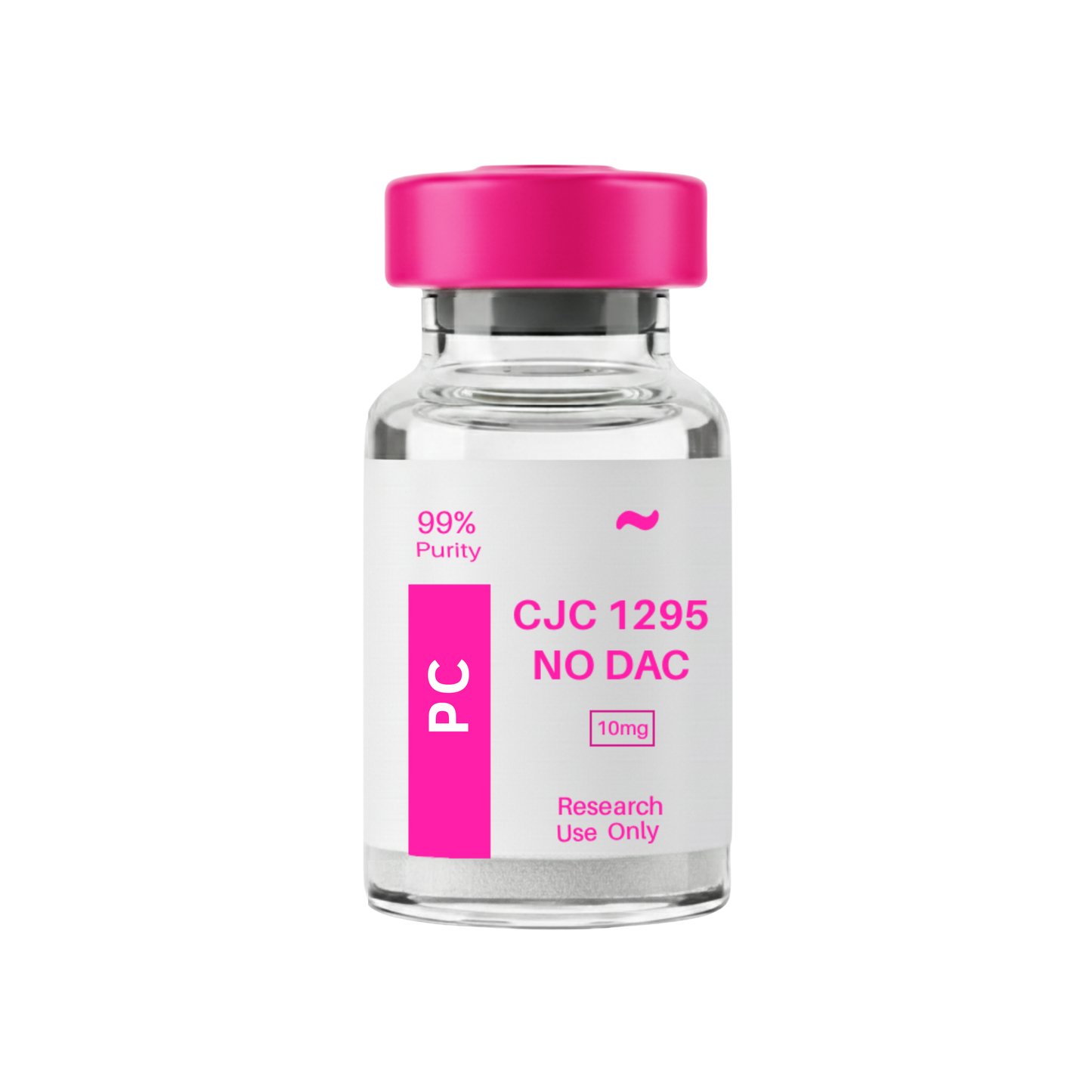
CJC-1295 (No DAC)
CJC-1295 (No DAC)
This batch of CJC-1295 (No DAC) Modified GRF Peptide has been third party lab tested and verified for quality.
Size: 5mg
Contents: CJC-1295 No DAC
Form: Powder
Purity: 99.0%
Couldn't load pickup availability
Free Reconstitution Solution automatically added to your cart with each order.
This product is Made, Tested & Shipped From Canada.
Ships Today
Order by 1:00 PM EST
Free Shipping
For 2 or more vials
Verified+

CJC-1295 (No DAC)
CJC-1295 (No DAC) is a 30–amino acid synthetic analog of growth hormone–releasing hormone (GHRH). It binds selectively to GHRH receptors on pituitary somatotrophs, stimulating pulsatile secretion of growth hormone (GH) and driving a secondary increase in insulin-like growth factor 1 (IGF-1). The “No DAC” designation signifies the absence of a Drug Affinity Complex (DAC) modification, yielding a shorter biological half-life and producing brief, controllable GH pulses rather than sustained elevation.
This transient action profile makes CJC-1295 (No DAC) well suited for experimental models that investigate GH/IGF-1 axis regulation, physiologic pulsatile signaling, anabolic metabolism, and tissue-regeneration processes under near-natural hormone-release dynamics.
CJC-1295 (No DAC) Overview
CJC-1295 (No DAC) is based on the native GHRH(1–29) fragment and contains four deliberate amino acid substitutions at positions 2, 8, 15, and 27. These substitutions enhance resistance to enzymatic degradation and improve structural stability while preserving physiologic affinity for the GHRH receptor.
In contrast to DAC-conjugated CJC-1295, which achieves prolonged half-life via albumin binding, the No DAC variant remains unbound in circulation and is cleared more rapidly. This supports a pattern of discrete GH pulses that closely resembles endogenous secretion. As a result, it is particularly valuable in research settings aimed at modeling natural GH rhythms and characterizing short-lived anabolic or metabolic responses.
CJC-1295 (No DAC) is frequently combined with growth hormone secretagogues (GHS) such as Ipamorelin or other GHRPs in experimental protocols. These combinations allow researchers to examine synergistic GH-axis modulation and to explore impacts on metabolism, tissue repair, and body composition under tightly controlled laboratory conditions.
CJC-1295 (No DAC) Research
Growth Hormone Stimulation and Mechanism of Action
CJC-1295 (No DAC) is a GHRH(1–29) analog engineered to maintain robust receptor activity together with improved enzymatic stability. The four targeted residue changes preserve high-affinity binding to GHRH receptors on pituitary somatotrophs, resulting in amplified but physiologic pulsatile GH secretion.
Unlike DAC-linked or other long-acting agonists that generate sustained GH elevations, the No DAC form induces distinct GH pulses aligned with normal endocrine rhythms. This pattern helps minimize receptor desensitization and excessive negative feedback associated with chronic stimulation. Preclinical work has documented clear dose-dependent increases in GH and IGF-1, providing a precise platform for investigating anabolic and metabolic control.
Metabolic and Body Composition Research
Studies using CJC-1295 (No DAC) have reported increases in circulating GH and IGF-1—key regulators of lipid metabolism, lean tissue growth, and nutrient partitioning. These observations support research into reduced adiposity, enhanced nitrogen retention, and the preservation of lean mass across diverse metabolic models.
When CJC-1295 (No DAC) is co-administered with GHS agents like Ipamorelin or GHRP-6, synergistic amplification of GH pulse amplitude and frequency is often observed. Such dual-peptide protocols are widely used to explore energy expenditure, glucose handling, mitochondrial function, and cellular repair in the context of metabolic efficiency, muscle recovery, and age-related sarcopenia.
Neurological and Regenerative Research Applications
The GH/IGF-1 axis contributes significantly to neurogenesis, synaptic plasticity, and neural repair. In laboratory models, CJC-1295 (No DAC) has been applied to investigate neuronal proliferation, glial-cell modulation, and vascular remodeling—processes central to cognitive performance and neural recovery after injury.
Because GH and IGF-1 also influence connective-tissue turnover, collagen synthesis, and angiogenesis, CJC-1295 (No DAC) is relevant in regenerative-medicine research on wound healing, musculoskeletal repair, and post-injury rehabilitation. Its ability to maintain a physiologic GH pulse profile allows researchers to isolate tissue-repair pathways without the confounding effects of sustained GH exposure.
Pharmacokinetic Properties and Research Advantages
Pharmacokinetically, CJC-1295 (No DAC) differs substantially from DAC-conjugated CJC-1295. The DAC-linked molecule exhibits a markedly extended half-life due to covalent binding to serum albumin, whereas the No DAC peptide is not albumin-bound and is cleared from plasma relatively quickly.
This shorter half-life enables precise control of GH stimulation timing. Dosing can be synchronized with narrow sampling windows to characterize acute hormone responses, receptor sensitivity, and feedback mechanisms. As such, CJC-1295 (No DAC) is especially useful in pulse-based GH studies, receptor-responsiveness profiling, and high-resolution metabolic-response experiments.
Summary and Research Use Notice
CJC-1295 (No DAC) is a research-only peptide used to study GH pulsatility, IGF-1 regulation, and related anabolic and regenerative signaling pathways. Its experimental applications include metabolism, neuroregeneration, connective-tissue biology, and endocrine pharmacology.
CJC-1295 (No DAC) is supplied exclusively for laboratory and scientific research. It is not intended for human or veterinary use, diagnosis, therapy, or consumption.
Article Author
This review was compiled and organized by Dr. Cyrill Y. Bowers, Ph.D., an internationally recognized endocrinologist and peptide biochemist best known for discovering and characterizing growth hormone–releasing peptides (GHRPs). His pioneering studies established how GHRH analogs and GHRPs synergize to stimulate pituitary GH secretion, laying the groundwork for modern GH secretagogue and analog research. Over decades, Dr. Bowers has significantly advanced understanding of hypothalamic–pituitary regulation and the therapeutic potential of GH-axis modulation.
Scientific Journal Author
Dr. Cyrill Y. Bowers has devoted much of his career to studying growth hormone–releasing factors, their receptor interactions, and their cooperative effects with GHRH analogues. Collaborations with leading endocrinologists—including L.A. Frohman, C.J. Strasburger, and E.E. Müller—have been instrumental in defining GH/IGF-1 physiology, pulsatile hormone dynamics, and endocrine feedback control.
His landmark article, “Discovery of Growth Hormone–Releasing Peptides” (Endocrine Reviews, 1998; 19(6):801–822), remains a foundational reference in GH secretagogue science.
This acknowledgment is provided solely to recognize the scholarly contributions of Dr. Bowers and his collaborators. Montreal Peptides Canada has no affiliation, sponsorship, or professional association with Dr. Bowers or any researchers cited herein.
Reference Citations
- Teichman SL, et al. CJC-1295, a long-acting GHRH analog: safety and pharmacokinetics. J Clin Endocrinol Metab. 2006;91(3):799–805. https://pubmed.ncbi.nlm.nih.gov/16352683/
- Frohman LA, et al. Growth hormone-releasing hormone: discovery and clinical relevance. Endocr Rev. 2000;21(1):1-47. https://pubmed.ncbi.nlm.nih.gov/10696565/
- Lapierre H, et al. CJC-1295 increases plasma IGF-1 in primate studies. Endocrinology. 2005;146(6):3052-3058. https://pubmed.ncbi.nlm.nih.gov/15746190/
- Pihoker C, et al. Growth hormone dynamics and feedback regulation. J Clin Endocrinol Metab. 1998;83(10):3417-3421. https://pubmed.ncbi.nlm.nih.gov/9768658/
- Bowers CY. Discovery of growth hormone-releasing peptides. Endocr Rev. 1998;19(6):801-822. https://pubmed.ncbi.nlm.nih.gov/9861543/
- Müller EE, et al. Hypothalamic control of GH secretion. Physiol Rev. 1999;79(2):511-607. https://pubmed.ncbi.nlm.nih.gov/10221987/
- Popovic V, et al. GH secretagogues and GHRH analogs in clinical research. J Endocrinol Invest. 2003;26(9):872-881. https://pubmed.ncbi.nlm.nih.gov/14628911/
- Jansson JO, et al. Pulsatile GH release and experimental regulation. Endocr Rev. 1985;6(2):128-150. https://pubmed.ncbi.nlm.nih.gov/2861011/
- Strasburger CJ, et al. GH and IGF-1 actions in tissue repair. Growth Horm IGF Res. 2000;10(Suppl B):S6-S8. https://pubmed.ncbi.nlm.nih.gov/10984265/
- Bowers CY, et al. Synergistic GH release with GHRH analogs and GHS peptides. J Clin Endocrinol Metab. 1990;70(4):975-982. https://pubmed.ncbi.nlm.nih.gov/2318961/
STORAGE
Storage Instructions
All products are produced through a lyophilization (freeze-drying) process, which preserves stability during shipping for approximately 3–4 months.
After reconstitution with bacteriostatic water, peptides must be stored in a refrigerator to maintain their effectiveness. Once mixed, they remain stable for up to 30 days.
Lyophilization, also known as cryodesiccation, is a specialized dehydration method in which peptides are frozen and exposed to low pressure. Water then sublimates directly from solid to gas, leaving a stable, white crystalline lyophilized peptide that can be safely stored at room temperature until reconstituted with bacteriostatic water.
For extended storage periods lasting several months to years, peptides should be kept in a freezer at -80°C (-112°F). Freezing under these conditions helps preserve structural integrity and ensures long-term stability.
Upon receiving peptides, they should be kept cool and protected from light. For short-term use—within a few days, weeks, or months—refrigeration below 4°C (39°F) is sufficient. Lyophilized peptides generally remain stable at room temperature for several weeks, making this acceptable for shorter pre-use storage.
Best Practices For Storing Peptides
Proper storage of peptides is critical for maintaining the accuracy and reliability of laboratory results. Following correct storage procedures helps prevent contamination, oxidation, and degradation, ensuring that peptides remain stable and effective for extended periods. Although some peptides are more prone to breakdown than others, applying best practices can significantly extend their lifespan.
Upon receipt, peptides should be kept cool and shielded from light. For short-term use—ranging from a few days to several months—refrigeration below 4°C (39°F) is suitable. Lyophilized peptides generally remain stable at room temperature for several weeks, making this acceptable for shorter storage durations.
For long-term preservation over several months or years, peptides should be stored in a freezer at -80°C (-112°F). Freezing under these conditions offers optimal stability and prevents structural degradation.
It is also essential to minimize freeze–thaw cycles, as repeated temperature fluctuations can accelerate degradation. Frost-free freezers should be avoided since they undergo temperature variations during defrosting, which can compromise peptide stability.
Preventing Oxidation and Moisture Contamination
It is essential to protect peptides from exposure to air and moisture, as both can compromise their stability. Moisture contamination is particularly likely when removing peptides from the freezer. To avoid condensation forming on the cold peptide or inside its container, always allow the vial to reach room temperature before opening.
Minimizing air exposure is equally important. The peptide container should remain closed as much as possible and, after removing the required amount, should be promptly resealed. Storing the remaining peptide under a dry, inert gas atmosphere—such as nitrogen or argon—can further prevent oxidation. Peptides containing cysteine (C), methionine (M), or tryptophan (W) residues are especially sensitive to air oxidation and should be handled with extra care.
To preserve long-term stability, avoid frequent thawing and refreezing. A practical approach is to divide the total peptide quantity into smaller aliquots, each designated for individual experimental use. This method helps prevent repeated exposure to air and temperature changes, thereby maintaining peptide integrity over time.
Storing Peptides In Solution
Peptide solutions have a significantly shorter shelf life compared with lyophilized forms and are more susceptible to bacterial degradation. Peptides containing cysteine (Cys), methionine (Met), tryptophan (Trp), aspartic acid (Asp), glutamine (Gln), or N-terminal glutamic acid (Glu) residues tend to degrade more rapidly when stored in solution.
If storage in solution is unavoidable, it is recommended to use sterile buffers with a pH between 5 and 6. The solution should be divided into aliquots to minimize freeze–thaw cycles. Under refrigerated conditions at 4°C (39°F), most peptide solutions remain stable for up to 30 days. However, peptides known to be less stable should be kept frozen when not in immediate use to maintain structural integrity.
Peptide Storage Containers
Containers used for storing peptides must be clean, clear, durable, and chemically resistant. They should also be appropriately sized to match the quantity of peptide being stored, minimizing excess air space. Both glass and plastic vials are suitable options, with plastic varieties typically made from either polystyrene or polypropylene. Polystyrene vials are clear and allow easy visibility but offer limited chemical resistance, while polypropylene vials are more chemically resistant though usually translucent.
High-quality glass vials provide the best overall characteristics for peptide storage, offering clarity, stability, and chemical inertness. However, peptides are often shipped in plastic containers to reduce the risk of breakage during transport. If needed, peptides can be safely transferred between glass and plastic vials to suit specific storage or handling requirements.
Peptide Storage Guidelines: General Tips
When storing peptides, it is important to follow these best practices to maintain stability and prevent degradation:
- Store peptides in a cold, dry, and dark environment.
- Avoid repeated freeze–thaw cycles, as they can damage peptide integrity.
- Minimize exposure to air to reduce the risk of oxidation.
- Protect peptides from light, which can cause structural changes.
- Do not store peptides in solution long term; keep them lyophilized whenever possible.
- Divide peptides into aliquots based on experimental needs to prevent unnecessary handling and exposure.
-

HIGHEST QUALITY PEPTIDES
Our products are scientifically formulated and manufactured in cGMP-compliant facilities.
-

FAST DELIVERY
Enjoy fast and reliable 3–5 day shipping.
-

Dedicated Customer Service
Our customer service team is highly knowledgeable in peptide research and its applications. We’re available 24/7 to assist you.
Verified reviews
Tested. Verified. Trusted.
We take a laboratory-first approach to quality. Each batch is made under controlled conditions and verified by an independent lab (HPLC/MS). We only ship batches that test ≥99% purity, and we provide a full COA, including identity, methods, and chromatograms, for your review.
Shop now
See the Process for Yourself
We make our peptides in our own cGMP lab. Watch the video to see how every vial is produced, tested, and handled with care.
Science Behind Our Peptides
A clear explanation of how our peptides work, their benefits, why quality matters for best results, and what you should know.
You may also like
-
SAVE 25%Reconstitution Solution
Regular price $15.00Regular price $15.00 Sale priceUnit price / per$20.0025% -
BPC-157 + TB-500 + GHK-Cu Peptide Blend - Research Grade Peptide Compound
Regular price $139.00Regular price $139.00 Sale priceUnit price / per$181.0023% -
Glow BPC-157 + GHK-CU + TB-500 - Premium Research Peptide
Regular price $139.00Regular price $139.00 Sale priceUnit price / per$181.0023% -
SAVE 25%Tirzepatide
Regular price From $50.00Regular price From $50.00 Sale priceUnit price / per$67.0025% -
Thymosin Alpha-1 - Premium Research Peptide
Regular price From $79.00Regular price From $79.00 Sale priceUnit price / per$104.0024% -
SAVE 23%Tesamorelin
Regular price From $75.00Regular price From $75.00 Sale priceUnit price / per$98.0023% -
SAVE 23%Survodutide
Regular price From $299.00Regular price From $299.00 Sale priceUnit price / per$392.0023% -
SAVE 23%Sterile Water
Regular price From $13.00Regular price From $13.00 Sale priceUnit price / per$17.0023% -
SAVE 23%SLU-PP-332
Regular price From $113.00Regular price From $113.00 Sale priceUnit price / per$148.0023% -
SAVE 25%Sermorelin
Regular price From $63.00Regular price From $63.00 Sale priceUnit price / per$84.0025% -
SAVE 27%Semaglutide
Regular price From $32.00Regular price From $32.00 Sale priceUnit price / per$44.0027% -
SAVE 26%Oxytocin Acetate
Regular price From $38.00Regular price From $38.00 Sale priceUnit price / per$52.0026% -
SAVE 24%LL-37 - Premium Research Peptide
Regular price $85.00Regular price $85.00 Sale priceUnit price / per$112.0024% -
SAVE 23%Lipo-C with B Vitamins
Regular price From $73.00Regular price From $73.00 Sale priceUnit price / per$96.0023% -
SAVE 23%Lemon Bottle 10mg
Regular price From $75.00Regular price From $75.00 Sale priceUnit price / per$98.0023% -
SAVE 23%L-Carnitine
Regular price From $97.00Regular price From $97.00 Sale priceUnit price / per$127.0023% -
KPV Tripeptide - Premium Research Peptide
Regular price From $56.00Regular price From $56.00 Sale priceUnit price / per$74.0024% -
KLOW Blend - GHK-CU + TB-500 + BPC-157 + KPV 10mg
Regular price From $188.00Regular price From $188.00 Sale priceUnit price / per$246.0023% -
SAVE 25%Kisspeptin-10
Regular price From $63.00Regular price From $63.00 Sale priceUnit price / per$85.0025% -
SAVE 25%Ipamorelin
Regular price From $27.00Regular price From $27.00 Sale priceUnit price / per$36.0025% -
SAVE 26%Hyaluronic Acid
Regular price From $25.00Regular price From $25.00 Sale priceUnit price / per$34.0026% -
SAVE 23%HGH Fragment 176-191
Regular price From $87.00Regular price From $87.00 Sale priceUnit price / per$114.0023% -
SAVE 25%HGH 191AA (Somatropin)
Regular price From $50.00Regular price From $50.00 Sale priceUnit price / per$67.0025% -
SAVE 25%Gonadorelin
Regular price $50.00Regular price $50.00 Sale priceUnit price / per$67.0025% -
Glutathione - Premium Research Peptide
Regular price $83.00Regular price $83.00 Sale priceUnit price / per$109.0023% -
Glow BPC-157 + GHK-CU + TB-500 - Premium Research Peptide
Regular price $139.00Regular price $139.00 Sale priceUnit price / per$181.0023% -
SAVE 26%Epitalon (Epithalon)
Regular price From $28.00Regular price From $28.00 Sale priceUnit price / per$38.0026% -
SAVE 25%Dermorphin
Regular price From $50.00Regular price From $50.00 Sale priceUnit price / per$67.0025% -
SAVE 24%CJC-1295 with DAC
Regular price From $69.39Regular price From $69.39 Sale priceUnit price / per$92.0024% -
SAVE 23%CJC-1295 No DAC & Ipamorelin
Regular price From $90.30Regular price From $90.30 Sale priceUnit price / per$118.0023% -
SAVE 23%CJC-1295 (No DAC)
Regular price From $75.00Regular price From $75.00 Sale priceUnit price / per$98.0023%
Every vial we sell comes from a lab that follows current Good Manufacturing Practices (cGMP). That means each step of production is documented and controlled. Before a batch is released, it’s tested by independent third-party labs for purity, identity, and sterility. Certificates of analysis are available so you can see the exact test results.
Yes. The labs we work with use ISO-certified clean rooms where air quality, equipment, and handling procedures are tightly regulated. Staff are trained to pharmaceutical-grade standards. This ensures the peptides are produced in an environment that minimizes contamination risks.
Peptides in lyophilized (freeze-dried) form are stable at room temperature for transport. Once you receive them, refrigeration is recommended to maintain long-term integrity. We package every order securely to prevent damage and ship promptly, so your vials arrive in optimal condition.
We operate under strict in-house protocols that follow current Good Manufacturing Practices (cGMP). That means our team oversees the entire process from sourcing raw amino acids to the final lyophilized vial. Nothing is outsourced or repackaged. This gives us full control over purity, consistency, and sterility, and it’s why we can stand behind every single vial we ship.
Store them in the refrigerator, away from direct light and heat. If you need to keep them longer, some peptides can be stored frozen. Each vial comes with clear handling instructions so you know the proper conditions for stability.
The strongest proof is transparency. For every peptide, we can provide certificates of analysis, manufacturing documentation, and references to the published scientific research behind it. If you ever have questions, we’ll show you the data rather than ask you to take our word for it.
The difference is transparency. Most sites give you a product name and a price. We provide full batch testing, lab documentation, and direct access to certificates of analysis so you don’t have to guess what you’re getting. When you order from us, you know exactly what’s in the vial, where it was made, and how it was verified.