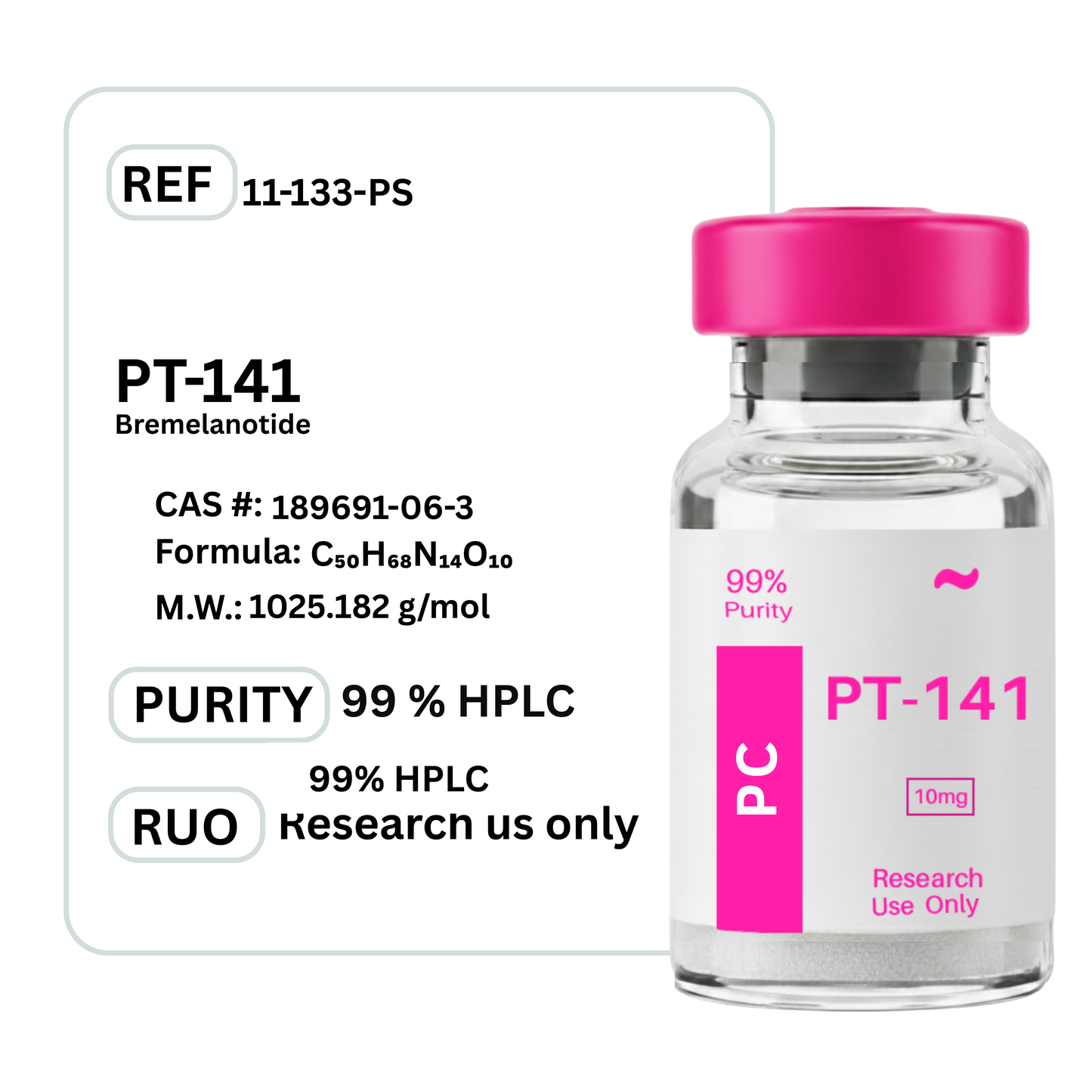
PT-141
PT-141
This batch of PT-141 Peptide has been third party lab tested and verified for quality.
Size: 10mg
Contents: PT-141
Form: Powder
Purity: 99.5%
Couldn't load pickup availability
Free Reconstitution Solution automatically added to your cart with each order.
This product is Made, Tested & Shipped From Canada.
Ships Today
Order by 1:00 PM EST
Free Shipping
For 2 or more vials
Verified+

PT-141 Peptide
PT-141 (Bremelanotide) is a synthetic, cyclic heptapeptide derived from the structure of melanocyte-stimulating hormone. This molecule functions as a highly specific melanocortin receptor agonist, primarily exhibiting high-affinity binding and activity at the MC3R and MC4R receptor subtypes within the central nervous system. Research on PT-141 is focused on elucidating its complex influence on sexual behavior, central nervous system (CNS) signaling, and the wider melanocortin pathway modulation that regulates energy and neuroendocrine function.
Unlike earlier compounds in the melanocortin family, PT-141 demonstrates minimal activity at the MC1R receptor. This is a crucial feature, as the MC1R subtype is the primary target associated with skin and hair pigmentation. This selective receptor profile makes PT-141 a unique and essential experimental agent for investigating central melanocortin mechanisms related to neural and behavioral regulation without the confounding effects of pigmentation processes.
PT-141 Peptide Overview
PT-141 was developed through a systematic structural refinement of the MSH analogue, Melanotan II. This modification was designed to significantly enhance its selectivity and potency toward the central melanocortin receptors (MC3R and MC4R) known to be associated with sexual function, energy regulation, and appetite control.
Experimental data strongly suggest that PT-141 influences hypothalamic neuronal activity. The hypothalamus is a key brain region for integrating neuroendocrine signals. By acting here, PT-141 is observed to modulate key processes, including sexual behavior, arousal mechanisms, and appetite control.
Preclinical investigations have comprehensively explored PT-141’s effects across various in-vitro models, including studies focusing on sexual dysfunction, metabolic balance, and neuroendocrine signaling. These studies confirm the compound's significance as a valuable research compound for dissecting the intricate roles of central melanocortin pathways in both neural and behavioral regulation.
PT-141 Peptide Structure
PT-141 is a linear chain of seven amino acids which forms a cyclic structure through a lactam bridge, significantly enhancing its metabolic stability and receptor binding affinity. Its chemical composition is defined by the following amino acid sequence:
- H-Cys-Glu-His-D-Phe-Arg-Trp-Lys-OH
The cyclic nature of PT-141 is formed by a covalent bond between the side chains of the Cysteine (Cys) and Lysine (Lys) residues.
Structure Solution Formula (Non-Chemical Notation):
C47 H64 N14 O10 S
Molecular Weight: 991.14 g/mol
The structural difference between PT-141 and its predecessor, Melanotan II, lies in the absence of the C-terminal amide group, which further contributes to its distinct pharmacological profile and enhanced selectivity for central receptors.
PT-141 Peptide Research
Melanocortin System and Sexual Function
Preclinical studies consistently demonstrate that PT-141 activates the MC3R and MC4R receptors within the hypothalamus, a critical region for regulating libido. This activation is shown to promote sexual arousal and copulatory behavior in both male and female experimental models. Crucially, unlike the peripheral action of phosphodiesterase type 5 inhibitors (PDE5i) such as sildenafil, PT-141's mechanism of action is primarily on central neural pathways. This makes it an indispensable experimental agent for investigating the fundamental neuroendocrine regulation of sexual function.
Neuroendocrine and Appetite Regulation
The central melanocortin signaling network is a key physiological system involved in maintaining systemic energy balance and appetite control. Research involving PT-141 has explored its effects on food intake suppression and weight regulation in various rodent models. These findings underscore the peptide's relevance in studies related to metabolic disorders and the complex interplay of neuroendocrine processes.
CNS Pharmacology and Safety
PT-141 is characterized by effective blood–brain barrier permeability and a high degree of receptor selectivity, which has prompted significant scientific interest in its potential for neuroendocrine and metabolic investigations. Preliminary safety evaluations in controlled experimental settings indicate a favorable pharmacological profile when administered via routes such as intranasal or subcutaneous injection.
Additional Research Applications
Further exploratory research has investigated PT-141’s potential in diverse areas, including ischemic protection (protection of tissue from oxygen deprivation), neuroinflammatory modulation, and broader behavioral neuroscience. These wide-ranging findings establish PT-141 as a versatile tool compound for advancing fundamental research into melanocortin receptor biology and their related central nervous system mechanisms.
PT-141 and Sexual Arousal
PT-141 is a specialized peptide recognized for its potent and selective ability to activate the MC4R receptor. This receptor is a central player in regulating sexual arousal and behavior via specific pathways within the central nervous system. Experimental research across various animal models has consistently demonstrated that agonist activity at MC4R receptors stimulates sexual motivation and copulatory behavior in both sexes.
Its action is distinct from common pharmacological agents for sexual dysfunction, which focus on peripheral vascular effects. PT-141 operates through a unique neurochemical mechanism, specifically targeting central arousal pathways. This makes it a promising compound for research focused on sexual arousal disorders that may originate from neurological rather than purely vascular causes in both men and women.
Clinical research involving men with erectile dysfunction (ED) who were unresponsive to sildenafil (a PDE5i) treatment found that a significant portion achieved satisfactory sexual performance following intranasal administration of PT-141. These studies observed a clear dose-dependent effect, supporting the compound’s efficacy in select central-nervous-system-related cases. These findings suggest that PT-141 provides valuable insights into addressing ED associated with central factors and contributes to understanding the neurobiological basis of low sexual desire.
PT-141 and Hemorrhage
Research in 2009 led to the development of a slightly modified version of PT-141 to explore its therapeutic potential in the context of hemorrhagic shock. Because PT-141 (and its modified form) acts as an agonist at both the MC1R and MC4R receptors, it has shown the ability to reduce ischemia and provide tissue protection against oxygen deprivation under conditions of severe blood loss (hypovolemic shock). When administered intravenously in research models, PT-141 did not exhibit major adverse effects. A modified compound, known as PL-6983, advanced through Phase IIb clinical trials, demonstrating encouraging protective effects without significant toxicity.
PT-141 and Infection
Experimental studies utilizing rat models of fungal infection revealed that the activation of the MC1R receptor by PT-141 can elicit notable antifungal and anti-inflammatory actions. This discovery holds significant relevance, as current antifungal medications are often limited by narrow mechanisms of action and can produce serious side effects that restrict long-term use. PT-141’s unique receptor-mediated activity positions it as a subject of interest for researching potential alternative therapeutic approaches for fungal infections, particularly in immunocompromised patients where reducing inflammation and infection-related mortality is critically important.
Reference Citations
Citation Number
Title and Journal
PubMed Link
1
Dorr RT, et al. Melanocortin receptor agonists and sexual function: discovery of PT-141. Ann N Y Acad Sci. 2003;994:96-102.
https://pubmed.ncbi.nlm.nih.gov/12851312/
2
Shadiack AM, et al. Melanocortin receptor agonists in sexual behavior research. Brain Res. 2007;1124(1):166–175.
https://pubmed.ncbi.nlm.nih.gov/17118440/
3
Hadley ME, et al. Discovery and development of melanocortin receptor ligands. Ann N Y Acad Sci. 2006;994:1-15.
https://pubmed.ncbi.nlm.nih.gov/12851309/
4
King SH, et al. PT-141: novel melanocortin analog in sexual arousal studies. J Sex Med. 2008;5(8):1939-1948.
https://pubmed.ncbi.nlm.nih.gov/18624943/
5
Giuliano F, et al. Central melanocortin pathways and erectile function. Int J Impot Res. 2007;19(1):17–23.
https://pubmed.ncbi.nlm.nih.gov/17043692/
6
Clayton AH, et al. Bremelanotide in female sexual dysfunction studies. J Sex Med. 2016;13(5):696-706.
https://pubmed.ncbi.nlm.nih.gov/27045212/
7
Wessells H, et al. Central melanocortin modulation of sexual function in humans. J Urol. 2000;164(3 Pt 1):738-743.
https://pubmed.ncbi.nlm.nih.gov/10953129/
8
van der Ploeg LH, et al. Melanocortin receptors and obesity research. Endocr Rev. 2002;23(6):728-743.
https://pubmed.ncbi.nlm.nih.gov/12466191/
9
Kask A, et al. Melanocortins in the brain: from pigmentation to appetite. Eur J Pharmacol. 1999;375(1-3):1–12.
https://pubmed.ncbi.nlm.nih.gov/10443489/
10
Wikberg JES, et al. Five subtypes of melanocortin receptors in energy homeostasis. Peptides. 1999;20(4):401-410.
https://pubmed.ncbi.nlm.nih.gov/10328292/
ALL ARTICLES AND PRODUCT INFORMATION PROVIDED ON THIS WEBSITE ARE FOR INFORMATIONAL AND EDUCATIONAL PURPOSES ONLY.
The products offered on this website are furnished for in-vitro studies only. In-vitro studies (Latin: in glass) are performed outside of the living body. These products are not medicines or drugs and have not been approved by the FDA to prevent, treat or cure any medical condition, ailment, or disease. Bodily introduction of any kind into humans or animals is strictly forbidden by law.
STORAGE
Storage Instructions
All products are manufactured through a specialized lyophilization (freeze-drying) process, which ensures and preserves the peptide's structural stability during shipping for a typical period of 3–4 months.
The process of lyophilization, also known as cryodesiccation, is a high-technology dehydration method. Peptides are first frozen, and then exposed to a very low pressure environment. This causes the water content to directly transition from a solid (ice) to a gas (vapor)—a process called sublimation. The result is a stable, white, crystalline structure known as a lyophilized peptide powder. This powder can be safely maintained at room temperature for a significant period until it is prepared for use (reconstituted) with bacteriostatic water.
After reconstitution with bacteriostatic water, the peptide solution must be stored in a refrigerator (typically below 4°C/39°F) to maintain its effectiveness. Once mixed, the peptide solution generally remains stable for up to 30 days.
For extended storage periods lasting several months to years, the optimal recommendation is to keep the lyophilized peptides in a freezer at -80°C (-112°F). Freezing under these ultra-low temperature conditions offers the highest level of stability, helping to maintain the peptide’s structural integrity over the long term.
Upon receipt of the peptide, it is essential to keep it cool and protected from light. For short-term use—meaning within a few days, weeks, or months—refrigeration below 4°C (39°F) is an adequate storage condition.
Best Practices For Storing Peptides
Proper storage of peptides is a critical factor in maintaining the accuracy and reliability of all laboratory research and results. Adhering to correct storage procedures is essential to prevent common issues such as contamination, oxidation, and degradation, which ensures the peptides remain stable and effective for their intended lifespan. While some peptides are inherently more susceptible to breakdown than others, consistently applying best storage practices will significantly extend their shelf life and preserve their molecular integrity.
A summary of ideal storage conditions is:
- Upon Receipt: Keep peptides cool and shielded from light.
- Short-Term Storage (Days to Months): Refrigeration below 4°C (39°F) is suitable. Lyophilized peptides have demonstrated stability at room temperature for several weeks, making this acceptable for very short durations before use.
- Long-Term Preservation (Months to Years): Peptides should be stored in a freezer at -80°C (-112°F) for optimal stability and to prevent structural degradation.
It is absolutely essential to minimize freeze-thaw cycles, as these repeated temperature fluctuations significantly accelerate peptide degradation. Furthermore, frost-free freezers must be avoided since they intentionally undergo temperature variations during their defrosting cycles, which can critically compromise peptide stability.
Preventing Oxidation and Moisture Contamination
It is paramount to protect peptides from exposure to air and moisture, as both elements can rapidly compromise their stability and integrity. Moisture contamination is a particularly high risk when removing a peptide vial from the freezer. To prevent condensation (which is the moisture that causes degradation) from forming on the cold peptide or inside its container, researchers must always allow the vial to fully reach room temperature before opening it.
Minimizing air exposure is equally important to prevent oxidation. The peptide container should remain closed as much as possible, and after removing the exact required amount for an experiment, the vial must be promptly resealed. For maximum long-term preservation, storing the remaining peptide under a dry, inert gas atmosphere—such as nitrogen or argon—can significantly further prevent oxidation. Peptides containing the amino acid residues cysteine (C), methionine (M), or tryptophan (W) are especially sensitive to air oxidation and require even greater care in handling.
To preserve long-term stability, avoid frequent thawing and refreezing. The most practical and effective approach is to divide the total peptide quantity into smaller, single-use aliquots, each designated for an individual experimental run. This method eliminates the need for repeated exposure to air and temperature changes, which effectively maintains peptide integrity over extended periods.
Storing Peptides In Solution
Peptide solutions have a significantly shorter shelf life compared to their lyophilized powder forms and are much more susceptible to bacterial degradation. Peptides containing the amino acid residues cysteine (Cys), methionine (Met), tryptophan (Trp), aspartic acid (Asp), glutamine (Gln), or N-terminal glutamic acid (Glu) tend to degrade the most rapidly when stored in solution.
If storage in solution is unavoidable for a specific experiment, it is strongly recommended to use sterile buffers with a pH between 5 and 6. The solution should be immediately divided into aliquots to minimize the impact of freeze-thaw cycles, which accelerate degradation. Under refrigerated conditions at 4°C (39°F), most peptide solutions maintain stability for up to 30 days. However, peptides that are known to be less stable must be kept frozen when not in immediate use to best maintain their structural integrity.
Peptide Storage Containers
Containers used for storing peptides must be demonstrably clean, clear, durable, and chemically resistant. They should also be appropriately sized to match the quantity of peptide being stored, minimizing excess air space. Both glass and plastic vials are suitable options. Plastic varieties are typically made from either polystyrene or polypropylene. Polystyrene vials are clear for easy visibility but offer limited chemical resistance, while polypropylene vials provide superior chemical resistance though they are usually translucent.
High-quality glass vials generally offer the best overall characteristics for long-term peptide storage, combining clarity, structural stability, and chemical inertness. However, peptides are often shipped in plastic containers to mitigate the risk of breakage during transport. If necessary, peptides can be safely transferred between high-quality glass and plastic vials to suit specific storage or handling requirements.
Peptide Storage Guidelines: General Tips
When storing peptides, it is imperative to follow these best practices to ensure maximum stability and prevent degradation:
- Store peptides in a cold, dry, and dark environment.
- Avoid repeated freeze-thaw cycles to prevent damage to peptide integrity.
- Minimize exposure to air to drastically reduce the risk of oxidation.
- Protect peptides from light, which can induce unwanted structural changes.
- Do not store peptides in solution long term; keep them lyophilized whenever physically possible.
- Divide peptides into aliquots based on experimental needs to prevent unnecessary handling and exposure of the bulk material.
-

HIGHEST QUALITY PEPTIDES
Our products are scientifically formulated and manufactured in cGMP-compliant facilities.
-

FAST DELIVERY
Enjoy fast and reliable 3–5 day shipping.
-

Dedicated Customer Service
Our customer service team is highly knowledgeable in peptide research and its applications. We’re available 24/7 to assist you.
Verified reviews
Tested. Verified. Trusted.
We take a laboratory-first approach to quality. Each batch is made under controlled conditions and verified by an independent lab (HPLC/MS). We only ship batches that test ≥99% purity, and we provide a full COA, including identity, methods, and chromatograms, for your review.
Shop now
See the Process for Yourself
We make our peptides in our own cGMP lab. Watch the video to see how every vial is produced, tested, and handled with care.
Science Behind Our Peptides
A clear explanation of how our peptides work, their benefits, why quality matters for best results, and what you should know.
You may also like
-
SAVE 25%Reconstitution Solution
Regular price $15.00Regular price $15.00 Sale priceUnit price / per$20.0025% -
BPC-157 + TB-500 + GHK-Cu Peptide Blend - Research Grade Peptide Compound
Regular price $139.00Regular price $139.00 Sale priceUnit price / per$181.0023% -
Glow BPC-157 + GHK-CU + TB-500 - Premium Research Peptide
Regular price $139.00Regular price $139.00 Sale priceUnit price / per$181.0023% -
SAVE 25%Tirzepatide
Regular price From $50.00Regular price From $50.00 Sale priceUnit price / per$67.0025% -
Thymosin Alpha-1 - Premium Research Peptide
Regular price From $79.00Regular price From $79.00 Sale priceUnit price / per$104.0024% -
SAVE 23%Tesamorelin
Regular price From $75.00Regular price From $75.00 Sale priceUnit price / per$98.0023% -
SAVE 23%Survodutide
Regular price From $299.00Regular price From $299.00 Sale priceUnit price / per$392.0023% -
SAVE 23%Sterile Water
Regular price From $13.00Regular price From $13.00 Sale priceUnit price / per$17.0023% -
SAVE 23%SLU-PP-332
Regular price From $113.00Regular price From $113.00 Sale priceUnit price / per$148.0023% -
SAVE 25%Sermorelin
Regular price From $63.00Regular price From $63.00 Sale priceUnit price / per$84.0025% -
SAVE 27%Semaglutide
Regular price From $32.00Regular price From $32.00 Sale priceUnit price / per$44.0027% -
SAVE 26%Oxytocin Acetate
Regular price From $38.00Regular price From $38.00 Sale priceUnit price / per$52.0026% -
SAVE 24%LL-37 - Premium Research Peptide
Regular price $85.00Regular price $85.00 Sale priceUnit price / per$112.0024% -
SAVE 23%Lipo-C with B Vitamins
Regular price From $73.00Regular price From $73.00 Sale priceUnit price / per$96.0023% -
SAVE 23%Lemon Bottle 10mg
Regular price From $75.00Regular price From $75.00 Sale priceUnit price / per$98.0023% -
SAVE 23%L-Carnitine
Regular price From $97.00Regular price From $97.00 Sale priceUnit price / per$127.0023% -
KPV Tripeptide - Premium Research Peptide
Regular price From $56.00Regular price From $56.00 Sale priceUnit price / per$74.0024% -
KLOW Blend - GHK-CU + TB-500 + BPC-157 + KPV 10mg
Regular price From $188.00Regular price From $188.00 Sale priceUnit price / per$246.0023% -
SAVE 25%Kisspeptin-10
Regular price From $63.00Regular price From $63.00 Sale priceUnit price / per$85.0025% -
SAVE 25%Ipamorelin
Regular price From $27.00Regular price From $27.00 Sale priceUnit price / per$36.0025% -
SAVE 26%Hyaluronic Acid
Regular price From $25.00Regular price From $25.00 Sale priceUnit price / per$34.0026% -
SAVE 23%HGH Fragment 176-191
Regular price From $87.00Regular price From $87.00 Sale priceUnit price / per$114.0023% -
SAVE 25%HGH 191AA (Somatropin)
Regular price From $50.00Regular price From $50.00 Sale priceUnit price / per$67.0025% -
SAVE 25%Gonadorelin
Regular price $50.00Regular price $50.00 Sale priceUnit price / per$67.0025% -
Glutathione - Premium Research Peptide
Regular price $83.00Regular price $83.00 Sale priceUnit price / per$109.0023% -
Glow BPC-157 + GHK-CU + TB-500 - Premium Research Peptide
Regular price $139.00Regular price $139.00 Sale priceUnit price / per$181.0023% -
SAVE 26%Epitalon (Epithalon)
Regular price From $28.00Regular price From $28.00 Sale priceUnit price / per$38.0026% -
SAVE 25%Dermorphin
Regular price From $50.00Regular price From $50.00 Sale priceUnit price / per$67.0025% -
SAVE 24%CJC-1295 with DAC
Regular price From $69.39Regular price From $69.39 Sale priceUnit price / per$92.0024% -
SAVE 23%CJC-1295 No DAC & Ipamorelin
Regular price From $90.30Regular price From $90.30 Sale priceUnit price / per$118.0023% -
SAVE 23%CJC-1295 (No DAC)
Regular price From $75.00Regular price From $75.00 Sale priceUnit price / per$98.0023%
Every vial we sell comes from a lab that follows current Good Manufacturing Practices (cGMP). That means each step of production is documented and controlled. Before a batch is released, it’s tested by independent third-party labs for purity, identity, and sterility. Certificates of analysis are available so you can see the exact test results.
Yes. The labs we work with use ISO-certified clean rooms where air quality, equipment, and handling procedures are tightly regulated. Staff are trained to pharmaceutical-grade standards. This ensures the peptides are produced in an environment that minimizes contamination risks.
Peptides in lyophilized (freeze-dried) form are stable at room temperature for transport. Once you receive them, refrigeration is recommended to maintain long-term integrity. We package every order securely to prevent damage and ship promptly, so your vials arrive in optimal condition.
We operate under strict in-house protocols that follow current Good Manufacturing Practices (cGMP). That means our team oversees the entire process from sourcing raw amino acids to the final lyophilized vial. Nothing is outsourced or repackaged. This gives us full control over purity, consistency, and sterility, and it’s why we can stand behind every single vial we ship.
Store them in the refrigerator, away from direct light and heat. If you need to keep them longer, some peptides can be stored frozen. Each vial comes with clear handling instructions so you know the proper conditions for stability.
The strongest proof is transparency. For every peptide, we can provide certificates of analysis, manufacturing documentation, and references to the published scientific research behind it. If you ever have questions, we’ll show you the data rather than ask you to take our word for it.
The difference is transparency. Most sites give you a product name and a price. We provide full batch testing, lab documentation, and direct access to certificates of analysis so you don’t have to guess what you’re getting. When you order from us, you know exactly what’s in the vial, where it was made, and how it was verified.