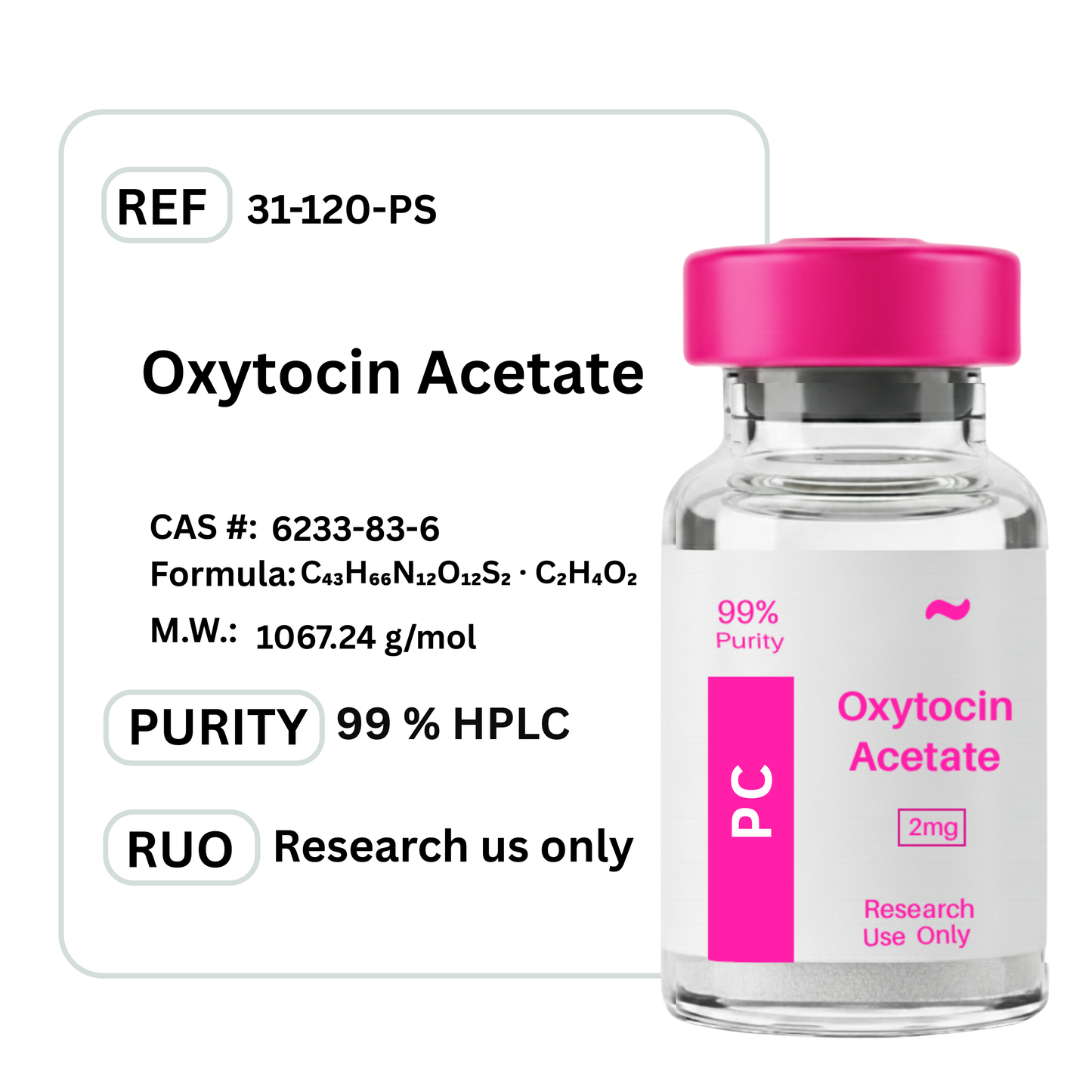
Oxytocin Acetate
Oxytocin Acetate
This batch of Oxytocin Acetate Peptide has been third party lab tested and verified for quality.
Size: 2mg
Contents: Oxytocin Acetate (Synthetic Nonapeptide)
Form: Lyophilized Powder
Purity: 99.3%
Couldn't load pickup availability
Free Reconstitution Solution automatically added to your cart with each order.
This product is Made, Tested & Shipped From Canada.
Ships Today
Order by 1:00 PM EST
Free Shipping
For 2 or more vials
Verified+

Oxytocin Acetate
Oxytocin Acetate is a certified, high-purity synthetic peptide designed for laboratory excellence, accurately replicating the biological structure and activity of the human neuropeptide, oxytocin. It is supplied as the stable acetate salt to ensure maximum solubility and fidelity in controlled, reproducible experimental research. Research applications are centered on investigating its core functions in neuromodulation, smooth muscle regulation, the neurocircuitry of social interaction, and systemic hormonal homeostasis. Investigators specifically study its binding characteristics and functional mechanisms at the oxytocin receptors in both the central and peripheral nervous systems under strictly defined experimental parameters.
This compound is an indispensable research standard across key disciplines, including behavioral neuroscience, reproductive biology, endocrine stress pathways, and cellular signaling research. Experimental studies routinely examine its influence on physiological cascades, the quantitative assessment of receptor binding affinity, and the subsequent activation of downstream cellular mechanisms mediated by secondary messenger systems.
Oxytocin Acetate Overview
Oxytocin Acetate is an essential reagent in experimental and biomedical research, enabling a thorough exploration of its diverse and vital physiological and behavioral actions. It is particularly valued in studies focusing on neuroendocrine regulation, the mechanisms of maternal and social behaviors, tissue contractility assays, and the maintenance of fluid and osmotic balance. By utilizing rigorous, controlled in vitro and in vivo laboratory models, researchers gain the necessary precision to map how oxytocin selectively engages its receptors and modulates specific signaling pathways throughout the body.
The high-quality data generated from these investigations yields necessary insights into oxytocin-responsive systems, particularly those involved in stress adaptation, social bonding, emotional control, and reproductive physiology. Furthermore, studies utilizing Oxytocin Acetate contribute significantly to advancing the understanding of this peptide hormone's broader functions, including its impact on learning, memory, trust perception, and immune system modulation.
In sum, Oxytocin Acetate is a fundamental research standard that facilitates the scientific investigation into the complex, interconnected function of the endocrine, nervous, and behavioral systems. The discoveries made using this tool are essential for establishing the scientific groundwork needed to develop therapeutic interventions for mental health conditions, reproductive disorders, and stress-related illnesses.
Oxytocin Acetate Structure
Oxytocin Acetate is a chemically defined cyclic nonapeptide. To assure the highest degree of experimental fidelity, the molecular identity and purity are rigorously verified for each batch; the analytical data for the current lot are provided below.
Parameter
Value
Observed Mass (MS)
711.9 Da
Purity (HPLC)
99.42%
Batch Number
2025007
Primary Retention Time
3.48 min
Instrument
LCMS-7800 Series (Calibrated)
Analytical Note
Primary peak confirmed with trace secondary peak area 0.58%
Oxytocin Acetate Research
Neuroendocrine Regulation Research
Oxytocin Acetate is strategically used in both central and peripheral studies to precisely characterize hormone-mediated communication within the endocrine and nervous systems. It enables researchers to isolate and study the receptor-specific signaling pathways that govern stress coping mechanisms, the kinetics of hormonal release, and the preservation of neurochemical homeostasis. This work provides valuable, foundational insights into the brain-endocrine interactions that modulate emotion, metabolic status, and behavior.
Behavioral Signaling Models
In behavioral neuroscience, this synthetic peptide is an essential tool for investigating how peptide signaling affects social, emotional, and cognitive behaviors. Controlled laboratory models are used to systematically evaluate its specific role in social recognition, pair-bonding, learning capacity, and trust via targeted experiments on its receptor system. This research is crucial for advancing the understanding of oxytocin’s involvement in conditions such as anxiety, depression, and autism spectrum disorders, which are often characterized by altered social and emotional function.
Reproductive and Smooth Muscle Studies
High-control in vitro and in vivo models employ Oxytocin Acetate to investigate its potent role in smooth muscle contraction, focusing especially on reproductive organs like the uterus and mammary glands. Researchers analyze how oxytocin signaling contributes to essential physiological events such as parturition (childbirth), lactation (milk ejection), and overall reproductive tissue function. This line of research also explores its potential regulatory effects on muscle repair and wound healing processes.
Fluid Balance and Homeostasis
Oxytocin is a key player in maintaining systemic fluid equilibrium and precise osmotic regulation. Experimental research focuses on its modulatory effect on aquaporin channels, the mechanisms of renal water reabsorption, and the integrated endocrine control systems that maintain essential hydration and electrolyte stability. The findings from these studies are essential for fully understanding oxytocin’s supporting role in optimal cardiovascular and renal health.
This compound is strictly intended for scientific research purposes only and must be handled exclusively by qualified professionals within controlled laboratory environments. It is not approved for human or veterinary use and should be used solely for experimental and educational investigations.
Article Author
This review was compiled, expertly organized, and edited by Dr. Sue Carter, Ph.D., a globally recognized behavioral neurobiologist. Dr. Carter is internationally distinguished for her foundational and influential research on oxytocin and its central role in social bonding and behavior.
Dr. Carter’s extensive investigations have provided definitive clarification of the neuroendocrine mechanisms through which oxytocin regulates attachment behaviors, stress response, and social interaction dynamics across a wide range of species. Her seminal findings have been instrumental in establishing the modern scientific view of oxytocin as a primary hormone and neuromodulator that governs critical emotional, physiological, and social processes.
Scientific Journal Author
Dr. Sue Carter, Ph.D.
Founding Director, The Kinsey Institute, Indiana University
Dr. Carter is a globally acclaimed authority in behavioral neuroendocrinology, particularly for her pioneering contributions in elucidating oxytocin’s essential function in social attachment, emotional stability, and reproductive health. Her scholarly work is featured in elite scientific publications, including Science, Nature Reviews Neuroscience, and Frontiers in Neuroendocrinology, reflecting her substantial impact on the field’s understanding of oxytocin’s physiological and behavioral roles.
Reference Citations
- Grinevich V, et al. Oxytocin signaling in the brain. Nat Rev Neurosci. 2016. https://pubmed.ncbi.nlm.nih.gov/27299909/
- Jurek B, Neumann ID. The oxytocin receptor system. Front Neuroendocrinol. 2018. https://pubmed.ncbi.nlm.nih.gov/29353006/
- Gimpl G, Fahrenholz F. Receptor interaction mechanisms. Physiol Rev. 2001. https://pubmed.ncbi.nlm.nih.gov/11152759/
- Lee HJ, et al. Oxytocin and social behavior research. Horm Behav. 2020. https://pubmed.ncbi.nlm.nih.gov/31923321/
- Marazziti D, et al. Neuroendocrine regulation studies. Curr Opin Psychiatry. 2020. https://pubmed.ncbi.nlm.nih.gov/31977630/
- Modi ME, Young LJ. Oxytocin in behavioral neuroscience. Neuropsychopharmacology. 2012. https://pubmed.ncbi.nlm.nih.gov/22277840/
- ClinicalTrials.gov. Oxytocin receptor target research. https://clinicaltrials.gov/ct2/show/NCT04839544
- Carter CS. Oxytocin pathways in physiology and behavior. Science. 2014. https://pubmed.ncbi.nlm.nih.gov/25124494/
- Stoop R. Neuromodulatory functions of oxytocin. Neuropharmacology. 2014. https://pubmed.ncbi.nlm.nih.gov/24440718/
ALL ARTICLES AND PRODUCT INFORMATION PROVIDED ON THIS WEBSITE ARE FOR INFORMATIONAL AND EDUCATIONAL PURPOSES ONLY.
The products offered on this website are furnished for in-vitro studies only. In-vitro studies (Latin: in glass) are performed outside of the body. These products are not medicines or drugs and have not been approved by the FDA to prevent, treat or cure any medical condition, ailment or disease. Bodily introduction of any kind into humans or animals is strictly forbidden by law.
STORAGE
Storage Instructions
All products are processed via a high-efficiency lyophilization (freeze-drying) technique, which ensures structural stability during shipping for approximately 3–4 months.
Once the peptide is reconstituted with bacteriostatic water, the resulting solution must be stored under refrigeration to maintain its activity and remains stable for a period of up to 30 days.
Lyophilization, or cryodesiccation, is a specialized dehydration method that involves freezing the peptide and subjecting it to low pressure. This controlled process causes the water to undergo sublimation (direct transition from solid to gas), yielding a stable, white crystalline powder known as a lyophilized peptide. This powder can be safely stored at ambient room temperature until the necessary step of reconstitution with bacteriostatic water.
For extended storage periods (several months to years), the established best practice is to store peptides in a freezer at -80°C (-112°F). This ultralow temperature condition is optimal for preserving the peptide’s structural integrity and guaranteeing its long-term stability.
Upon receipt, peptides should be kept cool and thoroughly protected from light. For short-term use (e.g., a few days, weeks, or months), refrigeration below 4°C (39°F) is sufficient. Lyophilized peptides typically remain stable at room temperature for several weeks, making this acceptable for short storage periods before use.
Best Practices For Storing Peptides
Strict adherence to proper peptide storage is absolutely essential for maintaining the accuracy, quality, and reproducibility of laboratory results. Correct procedures minimize the risk of contamination, oxidation, and structural degradation, thereby ensuring that the peptides remain stable and effective over extended periods. While the inherent stability varies, applying these best practices significantly extends their functional lifespan.
Storage Duration
State
Recommended Temperature
Notes
Short-Term (Days to Months)
Lyophilized
Below 4°C (39°F)
Acceptable at Room Temp for a few weeks.
Long-Term (Months to Years)
Lyophilized
-80°C (-112°F)
Optimal for structural integrity.
In Solution
Reconstituted
4°C (39°F)
Stable for up to 30 days; aliquot and freeze if needed.
Upon receipt, peptides must be kept cool and shielded from light. For short-term use, refrigeration below 4°C (39°F) is adequate. Lyophilized peptides are stable at room temperature for several weeks, suitable for brief holding periods.
For long-term preservation over months or years, peptides must be stored in a freezer at -80°C (-112°F). This provides the highest level of stability and protection against degradation.
It is critical to minimize freeze-thaw cycles, as repeated temperature fluctuations accelerate degradation. Furthermore, frost-free freezers must be avoided because their automatic defrosting cycles introduce destabilizing temperature variations.
Preventing Oxidation and Moisture Contamination
Protecting peptides from exposure to air and moisture is essential, as both rapidly compromise stability and purity. Moisture contamination is a particular risk when retrieving frozen peptides. To prevent condensation from forming on the cold peptide or inside its container, always allow the vial to fully equilibrate to room temperature before opening it.
Minimizing air exposure is equally paramount. The peptide container should be kept closed as much as possible, and it must be promptly resealed after the necessary amount is withdrawn. Storing the remaining peptide under a dry, inert gas (such as nitrogen or argon) is highly recommended to guard against oxidation. Peptides containing the sensitive residues cysteine (C), methionine (M), or tryptophan (W) are highly susceptible to air oxidation and require meticulous handling.
To ensure long-term stability, frequent thawing and refreezing must be strictly avoided. A practical and effective approach is to divide the total quantity into smaller, single-use aliquots. This method prevents repeated exposure to air and temperature changes, thereby maximizing the peptide’s long-term integrity.
Storing Peptides In Solution
Peptide solutions have a substantially shorter shelf life than lyophilized forms and are at a higher risk of bacterial degradation. Peptides containing residues such as cysteine (Cys), methionine (Met), tryptophan (Trp), aspartic acid (Asp), glutamine (Gln), or N-terminal glutamic acid (Glu) are known to degrade more rapidly when stored in solution.
If storage in solution is unavoidable, it is strongly recommended to use sterile buffers with a pH maintained between 5 and 6. The solution should be aliquoted immediately to minimize the degradation caused by freeze-thaw cycles. When refrigerated at 4°C (39°F), most peptide solutions remain stable for up to 30 days. However, peptides with lower inherent stability should be stored frozen when not in immediate use to preserve their structural integrity.
Peptide Storage Containers
Containers used for peptide storage must be clean, clear, durable, and chemically resistant. They should be appropriately sized to the volume of peptide, minimizing unnecessary air space. Both glass and plastic vials are suitable. Plastic options are typically fabricated from polystyrene or polypropylene. Polystyrene offers clarity but limited chemical resistance, while polypropylene provides better chemical resistance but is often translucent.
High-quality glass vials are generally considered the optimal choice for peptide storage, offering the best combination of clarity, structural stability, and chemical inertness. However, peptides are often shipped in plastic containers to mitigate the risk of breakage during transit. Peptides can be safely transferred between glass and plastic vials as needed to suit specific storage or experimental handling requirements.
Peptide Storage Guidelines: General Tips
Adherence to these fundamental best practices is essential for maintaining peptide stability and preventing degradation:
- Store peptides in a cold, dry, and dark environment.
- Avoid repeated freeze-thaw cycles to prevent structural damage.
- Minimize air exposure to reduce the risk of oxidation.
- Protect peptides from light, which can induce structural changes.
- Do not store peptides in solution long term; keep them lyophilized whenever possible.
- Aliquot peptides based on experimental needs to prevent unnecessary handling.
-

HIGHEST QUALITY PEPTIDES
Our products are scientifically formulated and manufactured in cGMP-compliant facilities.
-

FAST DELIVERY
Enjoy fast and reliable 3–5 day shipping.
-

Dedicated Customer Service
Our customer service team is highly knowledgeable in peptide research and its applications. We’re available 24/7 to assist you.
Verified reviews
Tested. Verified. Trusted.
We take a laboratory-first approach to quality. Each batch is made under controlled conditions and verified by an independent lab (HPLC/MS). We only ship batches that test ≥99% purity, and we provide a full COA, including identity, methods, and chromatograms, for your review.
Shop now
See the Process for Yourself
We make our peptides in our own cGMP lab. Watch the video to see how every vial is produced, tested, and handled with care.
Science Behind Our Peptides
A clear explanation of how our peptides work, their benefits, why quality matters for best results, and what you should know.
You may also like
-
SAVE 25%Reconstitution Solution
Regular price $15.00Regular price $15.00 Sale priceUnit price / per$20.0025% -
BPC-157 + TB-500 + GHK-Cu Peptide Blend - Research Grade Peptide Compound
Regular price $139.00Regular price $139.00 Sale priceUnit price / per$181.0023% -
Glow BPC-157 + GHK-CU + TB-500 - Premium Research Peptide
Regular price $139.00Regular price $139.00 Sale priceUnit price / per$181.0023% -
SAVE 25%Tirzepatide
Regular price From $50.00Regular price From $50.00 Sale priceUnit price / per$67.0025% -
Thymosin Alpha-1 - Premium Research Peptide
Regular price From $79.00Regular price From $79.00 Sale priceUnit price / per$104.0024% -
SAVE 23%Tesamorelin
Regular price From $75.00Regular price From $75.00 Sale priceUnit price / per$98.0023% -
SAVE 23%Survodutide
Regular price From $299.00Regular price From $299.00 Sale priceUnit price / per$392.0023% -
SAVE 23%Sterile Water
Regular price From $13.00Regular price From $13.00 Sale priceUnit price / per$17.0023% -
SAVE 23%SLU-PP-332
Regular price From $113.00Regular price From $113.00 Sale priceUnit price / per$148.0023% -
SAVE 25%Sermorelin
Regular price From $63.00Regular price From $63.00 Sale priceUnit price / per$84.0025% -
SAVE 27%Semaglutide
Regular price From $32.00Regular price From $32.00 Sale priceUnit price / per$44.0027% -
SAVE 26%Oxytocin Acetate
Regular price From $38.00Regular price From $38.00 Sale priceUnit price / per$52.0026% -
SAVE 24%LL-37 - Premium Research Peptide
Regular price $85.00Regular price $85.00 Sale priceUnit price / per$112.0024% -
SAVE 23%Lipo-C with B Vitamins
Regular price From $73.00Regular price From $73.00 Sale priceUnit price / per$96.0023% -
SAVE 23%Lemon Bottle 10mg
Regular price From $75.00Regular price From $75.00 Sale priceUnit price / per$98.0023% -
SAVE 23%L-Carnitine
Regular price From $97.00Regular price From $97.00 Sale priceUnit price / per$127.0023% -
KPV Tripeptide - Premium Research Peptide
Regular price From $56.00Regular price From $56.00 Sale priceUnit price / per$74.0024% -
KLOW Blend - GHK-CU + TB-500 + BPC-157 + KPV 10mg
Regular price From $188.00Regular price From $188.00 Sale priceUnit price / per$246.0023% -
SAVE 25%Kisspeptin-10
Regular price From $63.00Regular price From $63.00 Sale priceUnit price / per$85.0025% -
SAVE 25%Ipamorelin
Regular price From $27.00Regular price From $27.00 Sale priceUnit price / per$36.0025% -
SAVE 26%Hyaluronic Acid
Regular price From $25.00Regular price From $25.00 Sale priceUnit price / per$34.0026% -
SAVE 23%HGH Fragment 176-191
Regular price From $87.00Regular price From $87.00 Sale priceUnit price / per$114.0023% -
SAVE 25%HGH 191AA (Somatropin)
Regular price From $50.00Regular price From $50.00 Sale priceUnit price / per$67.0025% -
SAVE 25%Gonadorelin
Regular price $50.00Regular price $50.00 Sale priceUnit price / per$67.0025% -
Glutathione - Premium Research Peptide
Regular price $83.00Regular price $83.00 Sale priceUnit price / per$109.0023% -
Glow BPC-157 + GHK-CU + TB-500 - Premium Research Peptide
Regular price $139.00Regular price $139.00 Sale priceUnit price / per$181.0023% -
SAVE 26%Epitalon (Epithalon)
Regular price From $28.00Regular price From $28.00 Sale priceUnit price / per$38.0026% -
SAVE 25%Dermorphin
Regular price From $50.00Regular price From $50.00 Sale priceUnit price / per$67.0025% -
SAVE 24%CJC-1295 with DAC
Regular price From $69.39Regular price From $69.39 Sale priceUnit price / per$92.0024% -
SAVE 23%CJC-1295 No DAC & Ipamorelin
Regular price From $90.30Regular price From $90.30 Sale priceUnit price / per$118.0023% -
SAVE 23%CJC-1295 (No DAC)
Regular price From $75.00Regular price From $75.00 Sale priceUnit price / per$98.0023%
Every vial we sell comes from a lab that follows current Good Manufacturing Practices (cGMP). That means each step of production is documented and controlled. Before a batch is released, it’s tested by independent third-party labs for purity, identity, and sterility. Certificates of analysis are available so you can see the exact test results.
Yes. The labs we work with use ISO-certified clean rooms where air quality, equipment, and handling procedures are tightly regulated. Staff are trained to pharmaceutical-grade standards. This ensures the peptides are produced in an environment that minimizes contamination risks.
Peptides in lyophilized (freeze-dried) form are stable at room temperature for transport. Once you receive them, refrigeration is recommended to maintain long-term integrity. We package every order securely to prevent damage and ship promptly, so your vials arrive in optimal condition.
We operate under strict in-house protocols that follow current Good Manufacturing Practices (cGMP). That means our team oversees the entire process from sourcing raw amino acids to the final lyophilized vial. Nothing is outsourced or repackaged. This gives us full control over purity, consistency, and sterility, and it’s why we can stand behind every single vial we ship.
Store them in the refrigerator, away from direct light and heat. If you need to keep them longer, some peptides can be stored frozen. Each vial comes with clear handling instructions so you know the proper conditions for stability.
The strongest proof is transparency. For every peptide, we can provide certificates of analysis, manufacturing documentation, and references to the published scientific research behind it. If you ever have questions, we’ll show you the data rather than ask you to take our word for it.
The difference is transparency. Most sites give you a product name and a price. We provide full batch testing, lab documentation, and direct access to certificates of analysis so you don’t have to guess what you’re getting. When you order from us, you know exactly what’s in the vial, where it was made, and how it was verified.