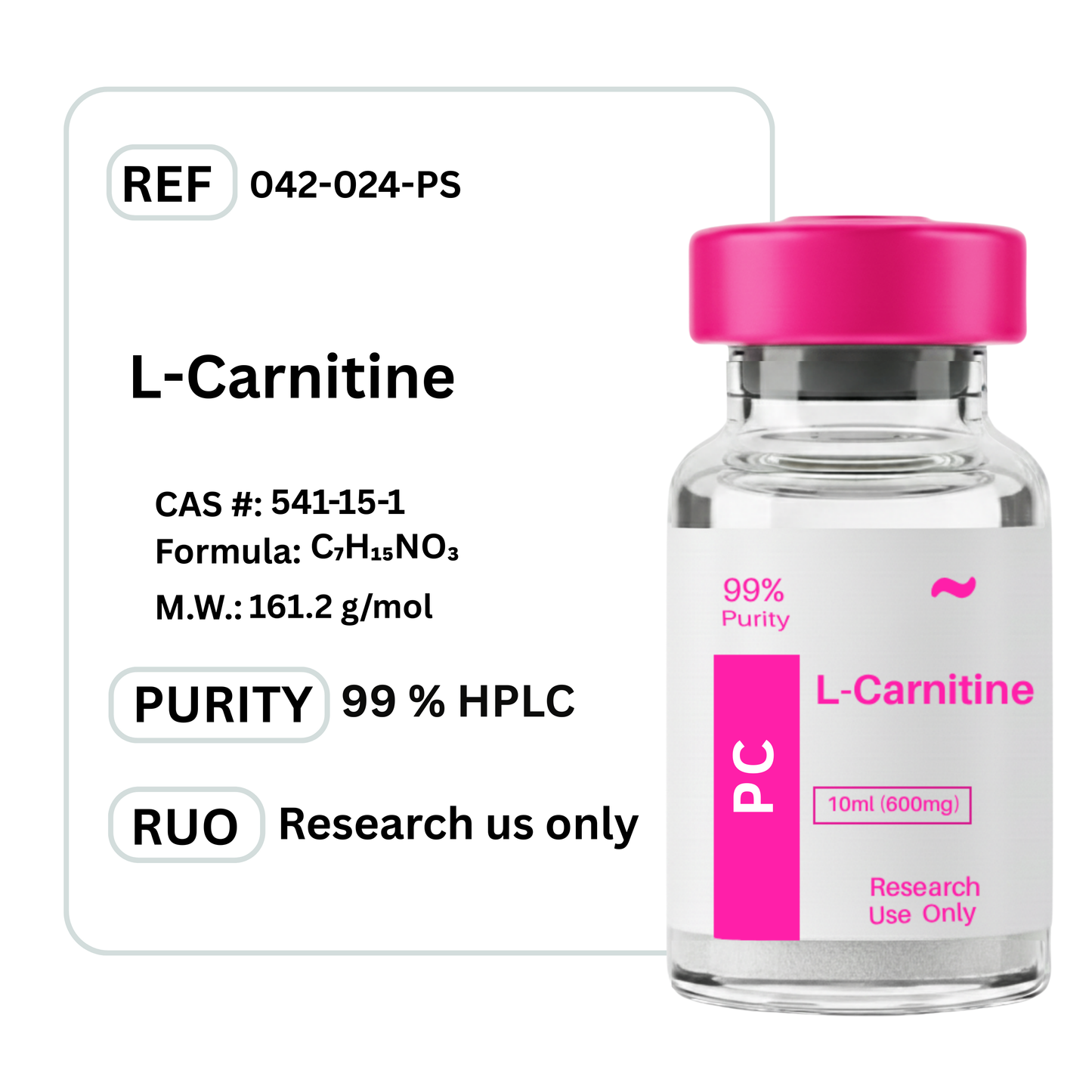
L-Carnitine
L-Carnitine
This batch of L-Carnitine Injectable Solution Peptide has been third party lab tested and verified for quality.
Size: L-Carnitine 10ml
Contents: L-Carnitine
Form: Liquid Solution
Purity: 99.83%
Couldn't load pickup availability
Free Reconstitution Solution automatically added to your cart with each order.
This product is Made, Tested & Shipped From Canada.
Ships Today
Order by 1:00 PM EST
Free Shipping
For 2 or more vials
Verified+

L-Carnitine Solution
L-Carnitine is a naturally occurring quaternary ammonium compound that is indispensable for cellular energy metabolism. Its primary function is the critical transport of long-chain fatty acids into the mitochondria, the internal structures where they are oxidized to produce energy. By enabling the efficient oxidation of these fatty acids, L-Carnitine acts as a key cofactor in mitochondrial metabolism, thereby supporting the generation of ATP, the core energy unit of the body.
The compound is synthesized endogenously from the amino acids lysine and methionine, but it is also obtainable from external dietary sources, specifically meat and dairy products. Extensive research continues to explore its significance across multiple physiological domains, particularly its role in maintaining cellular energy homeostasis, supporting muscle function and recovery, promoting cardiovascular wellness, and investigating neuroprotective benefits in research models.
L-Carnitine Solution -10 ml (600mg) Overview
L-Carnitine operates as an essential carrier molecule, facilitating the passage of long-chain fatty acids into the mitochondrial matrix by forming reversible acyl-carnitine esters. This transport mechanism across the inner mitochondrial membrane is the necessary first step for beta-oxidation, the key metabolic pathway responsible for breaking down fatty acids to release energy. The demand for L-Carnitine is highest in tissues with substantial energy needs, notably skeletal muscle, the heart (myocardium), and the liver, where continuous, high-efficiency energy metabolism is required for normal physiological operation.
Beyond its central role in fat transport, research indicates that L-Carnitine exhibits beneficial antioxidant properties. It aids in balancing elevated acyl-CoA levels and mitigates oxidative stress, offering a protective effect to cells against damage induced by high metabolic workloads. Through these combined metabolic and protective mechanisms, L-Carnitine supports overall cellular health and metabolic stability.
Multiple research models have been deployed to assess the functional utility of L-Carnitine, with studies investigating its influence on parameters such as exercise performance, muscle recovery kinetics, cardiovascular health markers, modulation of insulin resistance, and neurological support in disease models. In summary, these findings confirm L-Carnitine's critical and comprehensive involvement in energy regulation, antioxidant defense, and metabolic resilience.
L-Carnitine Solution Structure
Characteristic
Detail
Molecular Formula
C7H15N03
Molecular Weight
161.2 grams per mole
Chemical Structure Name
B-hydroxy-y-trimethylaminobutyric acid
Concentration
60 milligrams/ml (600 milligrams total in 10ml vial)
Synonyms
Levocarnitine, L-3-hydroxy-4-trimethylaminobutyrate
L-Carnitine Solution Research
Research Focus
Key Findings in Research Environments
Mitochondrial Energy Metabolism
Supports mitochondrial fatty acid beta-oxidation, which is vital for maintaining energy balance during fasting, physical exertion, and metabolic challenge. Studies on deficiency reveal impaired fatty acid breakdown and reduced energy output, confirming its status as a core mitochondrial cofactor.
Cardiovascular Function
Evidence suggests that L-Carnitine supplementation can enhance the heart's metabolic energy efficiency, protect against ischemia-reperfusion injury, and lead to reduced oxidative stress markers in cardiac tissue models.
Exercise and Muscle Recovery
Research in muscle physiology correlates L-Carnitine use with reduced exercise-induced accumulation of lactate, more efficient utilization of oxygen, and a faster rate of muscle recovery.
Neurological Models
Acetyl-L-carnitine derivatives have been studied for their neuroprotective capacity, ability to maintain mitochondrial health, and potential to improve cognitive performance in models of neurodegenerative conditions.
Insulin Sensitivity and Metabolism
Studies in both animal and human research models suggest L-Carnitine may be beneficial for glucose tolerance and insulin sensitivity by promoting fatty acid oxidation and reducing the accumulation of fat within muscle cells.
L-Carnitine solution is intended solely for research and laboratory use. Not for human consumption.
Article Author
This literature review was compiled, edited, and organized by Dr. Charles J. Rebouche, Ph.D. Dr. Rebouche is a distinguished biochemist recognized for his extensive work on carnitine metabolism, nutrient transport, and mitochondrial fatty acid oxidation. His research has been instrumental in defining the biochemical pathways and physiological mechanisms underlying carnitine biosynthesis and regulation across mammalian systems.
Scientific Journal Author
Dr. Charles J. Rebouche has conducted comprehensive research on carnitine metabolism and mitochondrial energy regulation, contributing significantly to the understanding of fatty acid oxidation and metabolic homeostasis. His findings—together with those of collaborators such as H. Seim, J. Bremer, and C.A. Stanley—have provided key insights into L-Carnitine's biochemical functions, its essential role in mitochondrial transport systems, and its clinical importance in energy metabolism.
Dr. Rebouche is acknowledged as one of the principal contributors to modern L-Carnitine research. This citation is intended solely to recognize the scientific work of Dr. Rebouche and his colleagues. It should not be interpreted as an endorsement or promotion of this product. Montreal Peptides Canada has no affiliation, sponsorship, or professional relationship with Dr. Rebouche or any of the researchers cited.
Reference Citations
- Rebouche CJ, Seim H. Carnitine metabolism and its regulation in microorganisms and mammals. Annu Rev Nutr. 1998;18:39-61. https://pubmed.ncbi.nlm.nih.gov/9706218/
- Bremer J. Carnitine - metabolism and functions. Physiol Rev. 1983;63(4):1420-1480. https://pubmed.ncbi.nlm.nih.gov/6359186/
- Stanley CA. Carnitine deficiency disorders in children. Ann NY Acad Sci. 2004;1033:42-51. https://pubmed.ncbi.nlm.nih.gov/15590996/
- Brass EP. Pharmacokinetic considerations for carnitine supplementation. Clin Ther. 1995;17(5):800-810. https://pubmed.ncbi.nlm.nih.gov/8847158/
- Calabrese V, et al. Acetyl-L-carnitine and neuroprotection. Mech Ageing Dev. 2006;127(6):492-504. https://pubmed.ncbi.nlm.nih.gov/16507360/
- Mingorance C, et al. Role of carnitine in exercise and energy metabolism. J Physiol Biochem. 2011;67(1):13-21. https://pubmed.ncbi.nlm.nih.gov/21249482/
- Arduini A, et al. L-Carnitine and protection against oxidative stress in heart and skeletal muscle. Free Radic Biol Med. 2008;44(8):1385-1394. https://pubmed.ncbi.nlm.nih.gov/18206666/
- Malaguarnera M. Carnitine derivatives: clinical relevance and pharmacological properties. Nutrients. 2019;11(9):2084. https://pubmed.ncbi.nlm.nih.gov/31514493/
- Longo N, et al. Primary and secondary carnitine deficiency syndromes. Am J Med Genet C Semin Med Genet. 2006;142C(2):77-85. https://pubmed.ncbi.nlm.nih.gov/16602102/
- Pignatti C, et al. Role of carnitine in human nutrition and metabolism. Nutrients. 2020;12(1):228. https://pubmed.ncbi.nlm.nih.gov/31906210/
ALL ARTICLES AND PRODUCT INFORMATION PROVIDED ON THIS WEBSITE ARE FOR INFORMATIONAL AND EDUCATIONAL PURPOSES ONLY. The products offered on this website are furnished for in-vitro studies only. In-vitro studies (Latin: in glass) are performed outside of the body. These products are not medicines or drugs and have not been approved by the FDA to prevent, treat or cure any medical condition, ailment or disease. Bodily introduction of any kind into humans or animals is strictly forbidden by law.
STORAGE
Storage Instructions
All products are prepared via the process of lyophilization (freeze-drying), which is engineered to maintain stability during shipping for an approximate period of 3-4 months. After the peptide is reconstituted using bacteriostatic water, it must be stored in a refrigerator to ensure its continued effectiveness. Once in solution, the product maintains stability for up to 30 days.
Lyophilization, also known as cryodesiccation, is a precise method of dehydration that involves freezing the peptide and then exposing it to low pressure. This process induces sublimation, where water transitions directly from its solid (ice) state to a gaseous state, resulting in a stable, white crystalline powder known as a lyophilized peptide. This dry powder form is stable for storage at room temperature until the point of reconstitution with bacteriostatic water.
For storage over extended periods, ranging from several months to years, the recommended temperature is a freezer set at -80 degrees Celsius (-112 degrees Fahrenheit). This deep-freeze environment is crucial for preserving the peptide's structural integrity and ensuring maximum long-term stability.
Upon receipt, it is essential to store peptides in a cool place, protected from light. For short-term experimental use—lasting a few days, weeks, or months—refrigeration below 4 degrees Celsius (39 degrees Fahrenheit) is sufficient. Lyophilized peptides generally maintain stability at room temperature for several weeks, making this an acceptable method for short-duration storage prior to use.
Best Practices For Storing Peptides
Following correct storage protocols is vital for achieving accurate and reliable laboratory results. Adhering to the right storage procedures helps prevent contamination, oxidation, and degradation, thereby guaranteeing the peptides remain stable and effective throughout their useful lifespan. While the susceptibility to breakdown varies between different peptides, applying these best practices can significantly enhance their longevity and preserve their integrity.
Immediately upon receipt, peptides should be stored in a cool environment, protected from light. For short-term experimental needs—ranging from a few days to several months—refrigeration below 4 degrees Celsius (39 degrees Fahrenheit) is suitable. Lyophilized peptides typically remain stable at room temperature for several weeks, which is acceptable for shorter storage periods.
For long-term storage, extending over several months to years, peptides should be placed in a freezer at -80 degrees Celsius (-112 degrees Fahrenheit). This deep-freezing temperature provides the optimal conditions for stability and protection against structural degradation.
It is also important to minimize freeze-thaw cycles, as repeated temperature fluctuations can accelerate degradation. Furthermore, researchers should avoid using frost-free freezers, which introduce temperature variations during their automatic defrosting cycles, potentially compromising peptide stability.
Preventing Oxidation and Moisture Contamination
Protecting peptides from both air and moisture exposure is essential, as these elements can compromise stability. Moisture contamination is a particular risk when removing peptides from the freezer. To prevent condensation from forming on the cold peptide or inside the container, researchers should always allow the vial to fully warm up to room temperature before opening it.
Minimizing exposure to air is equally important for maintaining integrity. The peptide container must remain sealed as much as possible, and after removing the required amount, it should be promptly resealed. Storing the remaining peptide under a dry, inert gas atmosphere—such as nitrogen or argon—can provide an additional safeguard against oxidation. Peptides containing residues like cysteine (C), methionine (M), or tryptophan (W) are known to be especially sensitive to air oxidation and require extra careful handling.
To ensure long-term stability, repeated thawing and refreezing cycles must be avoided. A highly recommended strategy is to divide the total peptide quantity into smaller, single-use aliquots. This method prevents unnecessary exposure to air and temperature changes, thereby maintaining the peptide's integrity over time.
Storing Peptides In Solution
Peptide solutions have a substantially reduced shelf life compared to their lyophilized forms and are more susceptible to potential bacterial degradation. Peptides containing residues such as cysteine (Cys), methionine (Met), tryptophan (Trp), aspartic acid (Asp), glutamine (Gln), or N-terminal glutamic acid (Glu) are known to degrade more rapidly when stored in liquid form.
If solution storage is necessary, the use of sterile buffers with a pH between 5 and 6 is advised. The solution must be divided into aliquots to minimize the detrimental effects of freeze-thaw cycles, which accelerate degradation. Under refrigeration at 4 degrees Celsius (39 degrees Fahrenheit), most peptide solutions can maintain stability for up to 30 days. However, peptides with known lower stability should be kept frozen when not in immediate use to best preserve their structural integrity.
Peptide Storage Containers
Containers selected for peptide storage must be clean, transparent, durable, and chemically inert. They should also be sized appropriately relative to the peptide quantity to minimize excess air space. Both glass and plastic vials are suitable; plastic varieties are typically made from either polystyrene or polypropylene. Polystyrene vials offer clear visibility but have limited chemical resistance, while polypropylene vials are more chemically resistant but are generally translucent.
High-quality glass vials offer the optimal combination of clarity, stability, and chemical inertness for peptide storage. However, peptides are often shipped in plastic containers to minimize the risk of breakage during transport. Peptides can be safely transferred between glass and plastic vials as needed to accommodate specific storage or handling requirements.
Peptide Storage Guidelines: General Tips
To maintain optimal peptide stability and prevent degradation, follow these essential guidelines:
- Store peptides in an environment that is cold, dry, and dark.
- Avoid applying repeated freeze-thaw cycles, as they compromise peptide integrity.
- Minimize all exposure to air to reduce the potential for oxidation.
- Protect peptides from light exposure, which can cause structural changes.
- For long-term storage, do not store peptides in solution; keep them lyophilized whenever feasible.
- Divide peptides into single-use aliquots based on experimental needs to prevent unnecessary handling and exposure.
-

HIGHEST QUALITY PEPTIDES
Our products are scientifically formulated and manufactured in cGMP-compliant facilities.
-

FAST DELIVERY
Enjoy fast and reliable 3–5 day shipping.
-

Dedicated Customer Service
Our customer service team is highly knowledgeable in peptide research and its applications. We’re available 24/7 to assist you.
Verified reviews
Tested. Verified. Trusted.
We take a laboratory-first approach to quality. Each batch is made under controlled conditions and verified by an independent lab (HPLC/MS). We only ship batches that test ≥99% purity, and we provide a full COA, including identity, methods, and chromatograms, for your review.
Shop now
See the Process for Yourself
We make our peptides in our own cGMP lab. Watch the video to see how every vial is produced, tested, and handled with care.
Science Behind Our Peptides
A clear explanation of how our peptides work, their benefits, why quality matters for best results, and what you should know.
You may also like
-
SAVE 25%Reconstitution Solution
Regular price $15.00Regular price $15.00 Sale priceUnit price / per$20.0025% -
BPC-157 + TB-500 + GHK-Cu Peptide Blend - Research Grade Peptide Compound
Regular price $139.00Regular price $139.00 Sale priceUnit price / per$181.0023% -
Glow BPC-157 + GHK-CU + TB-500 - Premium Research Peptide
Regular price $139.00Regular price $139.00 Sale priceUnit price / per$181.0023% -
SAVE 25%Tirzepatide
Regular price From $50.00Regular price From $50.00 Sale priceUnit price / per$67.0025% -
Thymosin Alpha-1 - Premium Research Peptide
Regular price From $79.00Regular price From $79.00 Sale priceUnit price / per$104.0024% -
SAVE 23%Tesamorelin
Regular price From $75.00Regular price From $75.00 Sale priceUnit price / per$98.0023% -
SAVE 23%Survodutide
Regular price From $299.00Regular price From $299.00 Sale priceUnit price / per$392.0023% -
SAVE 23%Sterile Water
Regular price From $13.00Regular price From $13.00 Sale priceUnit price / per$17.0023% -
SAVE 23%SLU-PP-332
Regular price From $113.00Regular price From $113.00 Sale priceUnit price / per$148.0023% -
SAVE 25%Sermorelin
Regular price From $63.00Regular price From $63.00 Sale priceUnit price / per$84.0025% -
SAVE 27%Semaglutide
Regular price From $32.00Regular price From $32.00 Sale priceUnit price / per$44.0027% -
SAVE 26%Oxytocin Acetate
Regular price From $38.00Regular price From $38.00 Sale priceUnit price / per$52.0026% -
SAVE 24%LL-37 - Premium Research Peptide
Regular price $85.00Regular price $85.00 Sale priceUnit price / per$112.0024% -
SAVE 23%Lipo-C with B Vitamins
Regular price From $73.00Regular price From $73.00 Sale priceUnit price / per$96.0023% -
SAVE 23%Lemon Bottle 10mg
Regular price From $75.00Regular price From $75.00 Sale priceUnit price / per$98.0023% -
SAVE 23%L-Carnitine
Regular price From $97.00Regular price From $97.00 Sale priceUnit price / per$127.0023% -
KPV Tripeptide - Premium Research Peptide
Regular price From $56.00Regular price From $56.00 Sale priceUnit price / per$74.0024% -
KLOW Blend - GHK-CU + TB-500 + BPC-157 + KPV 10mg
Regular price From $188.00Regular price From $188.00 Sale priceUnit price / per$246.0023% -
SAVE 25%Kisspeptin-10
Regular price From $63.00Regular price From $63.00 Sale priceUnit price / per$85.0025% -
SAVE 25%Ipamorelin
Regular price From $27.00Regular price From $27.00 Sale priceUnit price / per$36.0025% -
SAVE 26%Hyaluronic Acid
Regular price From $25.00Regular price From $25.00 Sale priceUnit price / per$34.0026% -
SAVE 23%HGH Fragment 176-191
Regular price From $87.00Regular price From $87.00 Sale priceUnit price / per$114.0023% -
SAVE 25%HGH 191AA (Somatropin)
Regular price From $50.00Regular price From $50.00 Sale priceUnit price / per$67.0025% -
SAVE 25%Gonadorelin
Regular price $50.00Regular price $50.00 Sale priceUnit price / per$67.0025% -
Glutathione - Premium Research Peptide
Regular price $83.00Regular price $83.00 Sale priceUnit price / per$109.0023% -
Glow BPC-157 + GHK-CU + TB-500 - Premium Research Peptide
Regular price $139.00Regular price $139.00 Sale priceUnit price / per$181.0023% -
SAVE 26%Epitalon (Epithalon)
Regular price From $28.00Regular price From $28.00 Sale priceUnit price / per$38.0026% -
SAVE 25%Dermorphin
Regular price From $50.00Regular price From $50.00 Sale priceUnit price / per$67.0025% -
SAVE 24%CJC-1295 with DAC
Regular price From $69.39Regular price From $69.39 Sale priceUnit price / per$92.0024% -
SAVE 23%CJC-1295 No DAC & Ipamorelin
Regular price From $90.30Regular price From $90.30 Sale priceUnit price / per$118.0023% -
SAVE 23%CJC-1295 (No DAC)
Regular price From $75.00Regular price From $75.00 Sale priceUnit price / per$98.0023%
Every vial we sell comes from a lab that follows current Good Manufacturing Practices (cGMP). That means each step of production is documented and controlled. Before a batch is released, it’s tested by independent third-party labs for purity, identity, and sterility. Certificates of analysis are available so you can see the exact test results.
Yes. The labs we work with use ISO-certified clean rooms where air quality, equipment, and handling procedures are tightly regulated. Staff are trained to pharmaceutical-grade standards. This ensures the peptides are produced in an environment that minimizes contamination risks.
Peptides in lyophilized (freeze-dried) form are stable at room temperature for transport. Once you receive them, refrigeration is recommended to maintain long-term integrity. We package every order securely to prevent damage and ship promptly, so your vials arrive in optimal condition.
We operate under strict in-house protocols that follow current Good Manufacturing Practices (cGMP). That means our team oversees the entire process from sourcing raw amino acids to the final lyophilized vial. Nothing is outsourced or repackaged. This gives us full control over purity, consistency, and sterility, and it’s why we can stand behind every single vial we ship.
Store them in the refrigerator, away from direct light and heat. If you need to keep them longer, some peptides can be stored frozen. Each vial comes with clear handling instructions so you know the proper conditions for stability.
The strongest proof is transparency. For every peptide, we can provide certificates of analysis, manufacturing documentation, and references to the published scientific research behind it. If you ever have questions, we’ll show you the data rather than ask you to take our word for it.
The difference is transparency. Most sites give you a product name and a price. We provide full batch testing, lab documentation, and direct access to certificates of analysis so you don’t have to guess what you’re getting. When you order from us, you know exactly what’s in the vial, where it was made, and how it was verified.