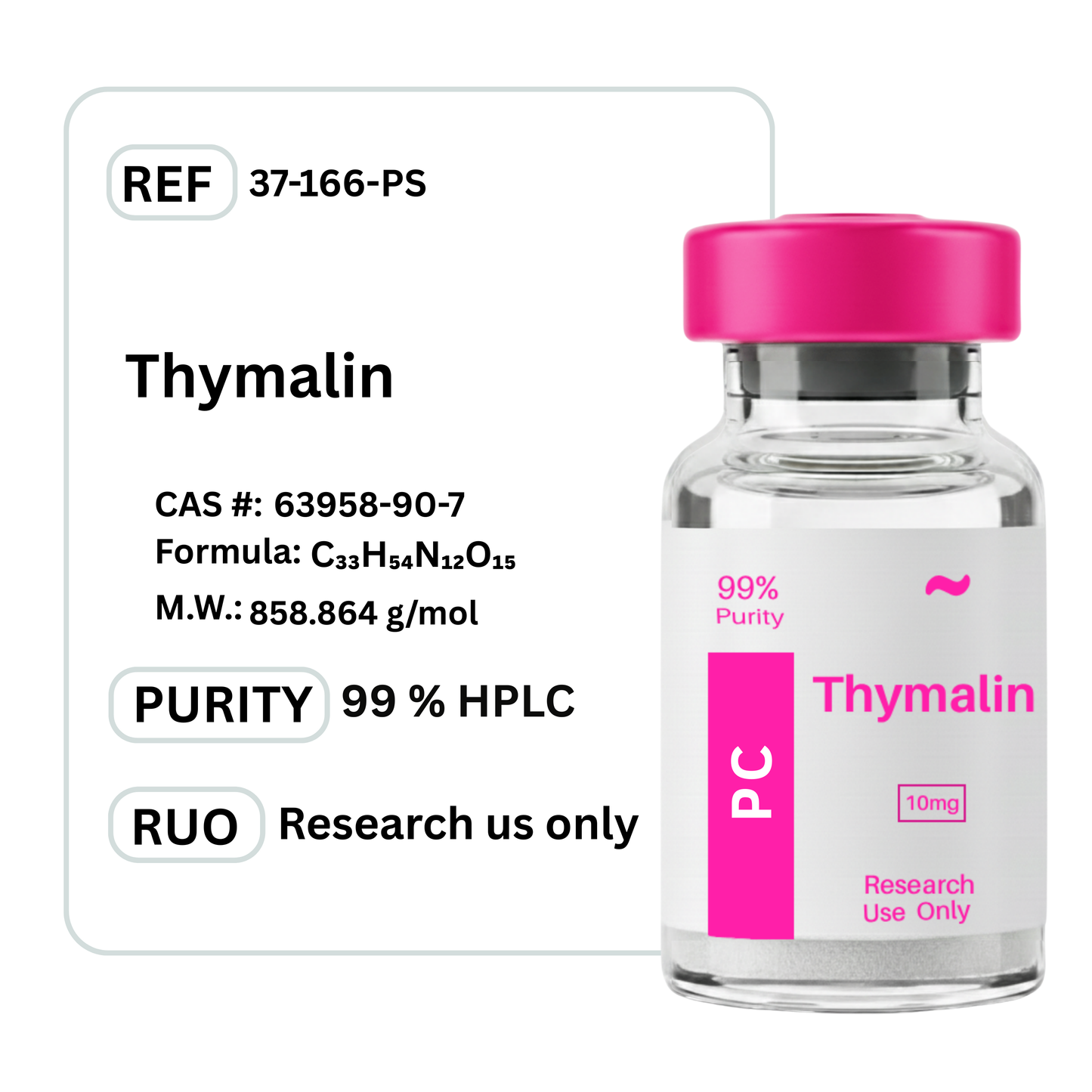
Thymalin
Thymalin
This batch of Thymalin Peptide has been third party lab tested and verified for quality.
Size: 10mg
Contents: Thymalin (Thymic Peptide Complex)
Form: Powder
Purity: 99.3%
Couldn't load pickup availability
Free Reconstitution Solution automatically added to your cart with each order.
This product is Made, Tested & Shipped From Canada.
Ships Today
Order by 1:00 PM EST
Free Shipping
For 2 or more vials
Verified+

Thymalin Peptide
Thymalin is a precisely synthesized tetrapeptide developed as a highly effective analog of thymulin, a native immunomodulatory peptide first isolated from the thymus gland in 1977. Its broad bio-regulatory profile is a key feature of its research application. Thymalin has been repeatedly observed to contribute to the balanced regulation of inflammation and pain transmission and exhibits notable neuroprotective capabilities. Primarily, the peptide is central to restoring and fortifying balanced immune system function. Initial, high-impact studies also suggested that Thymalin, especially in combination with extracts from the pineal gland, may offer significant avenues for research into longevity and systemic physiological rejuvenation.
Thymalin Peptide - 10 mg Overview
Thymalin is categorized within a critical group of biologically active thymic peptides essential for effective immune system modulation. Its mechanism of action involves the targeted influence on the differentiation, maturation, and functional programming of T-lymphocytes (T-cells). Research confirms that Thymalin can actively contribute to the normalization of various immunological markers that often become dysfunctional in contexts of age-related decline, chronic stress, or immune system suppression.
Mechanistic studies indicate that Thymalin acts as a powerful regulatory signal for hematopoietic stem and progenitor cells residing in the bone marrow and thymus. This function is believed to orchestrate the proper balance between the two main arms of adaptive immunity: T-cell and B-cell activity. Consequently, Thymalin is widely used as a model compound for research dedicated to deciphering thymus-derived hormonal signals, the intricate regulation of the cytokine network, and the therapeutic potential for robust immune restoration.
Thymalin Peptide Structure
Thymalin is a tetrapeptide of defined sequence and structure, crucial for its biological specificity. The following is a plain text representation of its solution formula.
Structure Solution Formula (Non-LaTex): L-Glutamyl-L-aspartyl-L-prolyl-L-arginine
Technical Specification
Detail
IUPAC Designation
N-(N(2)-L-arginyl-L-prolyl)-L-alpha-aspartyl)-L-glutamic acid
Sequence Abbreviation
Glu-Asp-Pro-Arg
Chemical Formula
C20H32N8O9
Physical State
Lyophilized Powder
Thymalin Peptide Research
Thymalin Research and Life Extension
Landmark Russian gerontological studies conducted from the early 2000s have demonstrated Thymalin’s potential to induce a profound restorative effect on multiple core physiological systems in elderly subjects. Clinical observations included documented improvements in cardiovascular, immune, and nervous system functions, coupled with enhanced metabolic efficiency and a measurable return to systemic homeostasis comparable to younger biological ages.
The data reported a substantial reduction in the incidence of common pathologies associated with aging, including acute respiratory infections, hypertension, osteoporosis, ischemic heart disease, and symptoms of arthritis. Most notably, the Thymalin-treated cohort demonstrated a twofold reduction in overall mortality during the course of the study. Furthermore, when Thymalin was combined with the pineal extract Epithalamin, a powerful synergistic effect was observed, leading to a reduction in mortality by up to fourfold. This finding provides strong validation for the co-regulatory relationship between the pineal and thymus glands in controlling the pace of biological aging.
Thymalin Research and Immune System Function
The research firmly establishes Thymalin's specialized role in regulating cellular immunity. Its activity involves the targeted modulation of lymphocyte ratios, the fine-tuning of T-cell differentiation, and the optimization of Natural Killer (NK) cell cytotoxicity. This mechanism is highly relevant for researchers studying chronic conditions, such as diabetes, where a breakdown of cellular immunity can lead to a state of immunosuppression and increased vulnerability to infections, chronic inflammation, and malignant transformation.
In clinical models of diabetic retinopathy, Thymalin administration was shown to restore immune balance, promote healthy T-lymphocyte proliferation, and correlate with decreased inflammatory markers, suggesting a slower rate of disease progression. Its potential for immune system repair is also investigated in the context of HIV-related immune dysfunction, where its co-administration with HAART may help increase CD4+ T-cell counts. Furthermore, Thymalin is a candidate for use as a vaccine adjuvant, as its ability to enhance T-cell-mediated responses suggests improved immune protection against various virulent pathogens.
Thymalin Research and Cancer
Pre-clinical data from mouse models suggests that Thymalin may be an effective adjunct agent when used alongside pulsed laser radiation for the treatment of specific cancers, such as melanoma, where the goal is often to prevent local spread and metastasis. The combined approach, including Thymalin administration, has been shown to stimulate antibody-forming cell production in the spleen, resulting in enhanced tumor suppression and improved overall treatment efficacy.
Thymalin has also been found to possess intrinsic anti-tumor properties. Studies in rats indicated that sub-therapeutic doses could significantly inhibit tumor growth in nearly 80% of cases and induce tumor regression in over half of the tested animals. In chronic lympholeukemia treatment, the combination of Thymalin with plasmapheresis has been reported to be more effective than standard chemotherapy in restoring hematological balance and lymphoid function, thereby accelerating the normalization of blood parameters and the onset of clinical remission.
Thymalin and Psoriasis
Clinical research combining Thymalin with standard treatment protocols for psoriasis—a chronic inflammatory skin and joint disorder—has yielded documented improvements in laboratory markers associated with the condition. These positive immunological shifts are linked to observable improvements in clinical outcomes, indicating a measurable benefit to disease status and overall patient health.
Thymalin Research and Tuberculosis
Clinical trials on patients with advanced pulmonary tuberculosis (TB) demonstrated that the addition of Thymalin to standard antibiotic therapy resulted in significantly higher clinical cure rates compared to antibiotic monotherapy. This success rate approached 95% when the Thymalin–antibiotic protocol was personalized based on the patient's immune status. This highlights Thymalin's potential utility in overcoming the severe cellular immunity deficit that characterizes late-stage TB, by restoring the host’s critical ability to combat the persistent infection.
Thymalin and Kidney Disease
Research suggests a therapeutic role for Thymalin in patients with chronic glomerulonephritis, an inflammatory condition of the kidneys. A Russian clinical trial reported that Thymalin treatment was associated with significant improvements in renal function markers and reduced systemic inflammation. Immunological analysis suggested better regulation of disease-specific immune activity, which may slow the rate of kidney damage and potentially lead to partial remission or a delay in the need for renal replacement therapy.
Thymalin and Circadian Rhythm Disturbances
Animal models indicate a direct connection between thymic function and circadian rhythm regulation, which impacts global immunity. Seasonal changes are hypothesized to impair thymus function, leading to decreased immune performance. While not a primary chronobiotic, Thymalin appears to mitigate the resulting immune deficiencies associated with disrupted sleep-wake cycles. This suggests its potential as a prophylactic research agent against seasonal infections.
Thymalin Research and Heart Disease and Atherosclerosis
Cardiovascular research suggests Thymalin may assist in both the prevention and reversal of heart disease by contributing to lower lipid profiles and influencing the T-cells involved in clearing atherosclerotic plaque. Thymalin's ability to regulate T-cell suppressor activity and improve immune sensitivity targets the underlying immune dysfunction that contributes to the pathogenesis of atherosclerosis.
Thymalin Research and Postoperative Risk and Complications
Russian clinical studies support Thymalin's role in reducing postoperative infections and inflammation-related complications. By enhancing immune surveillance and lowering infection risk, Thymalin is proposed to significantly decrease postoperative mortality rates, potentially increasing the safety profile for high-risk surgical patients and accelerating recovery kinetics.
Thymalin Research and Gum Disease
Periodontitis is a chronic inflammatory disorder that causes tooth loss. Research indicates that Thymalin may assist by reducing localized inflammation and enhancing the necessary mucosal immune responses required to eliminate the causative bacterial pathogens.
Thymalin Research and Anorexia
Severe immune suppression and thyroid hormone dysregulation are common in anorexia nervosa. Studies suggest Thymalin can help reverse these immune disturbances and potentially facilitate the regeneration of atrophied thymic tissue. Since Thymalin is an intrinsically zinc-dependent peptide, concurrent zinc supplementation is considered necessary for maximal efficacy in research involving zinc-deficient patients. This product is provided strictly for laboratory research use only and is not intended for human consumption.
Article Author
This scientific review was composed and organized by Dr. Vladimir Khavinson, Ph.D., a highly esteemed biogerontologist and peptide scientist. Dr. Khavinson is recognized internationally for his seminal work on thymic and pineal peptides, including Thymalin and Epithalamin. His research focus is the precise biological activity of short peptides in modulating immune function, promoting regeneration, and mitigating age-related physiological decline. He is the founder of the St. Petersburg Institute of Bioregulation and Gerontology and has contributed extensively to the peer-reviewed literature on geroprotective peptides.
Scientific Journal Author
Dr. Vladimir Khavinson has conducted a broad spectrum of investigations into thymic peptides, covering immune modulation, hematopoiesis, and the aging process. His collaborators, including Dr. Vladimir G. Morozov, Dr. Nina S. Linkova, Dr. Vladimir N. Anisimov, Dr. Svetlana I. Tarnovskaya, and Dr. Vaclav Vetvicka, have published pivotal work on Thymalin’s influence on immune homeostasis and longevity. Their research has appeared in prominent journals such as Mechanisms of Ageing and Development, Pathophysiology, and Biogerontology. This recognition is purely academic and does not imply product endorsement.
Reference Citations
Khavinson VKh, Morozov VG, et al. "Peptide bioregulators of thymic origin: mechanisms of action." Bull Exp Biol Med. 2001;131(4):356- 358, https://pubmed.ncbi.nlm.nih.gov/11443912/
Anisimov VN, Khavinson VKH, et al. "Thymic peptides and immunoregulatory activity in aging." Mech Ageing Dev. 2002;123(8):1087- 1093. https://pubmed.ncbi.nlm.nih.gov/12044938/
Khavinson VKh, et al. "Thymalin: peptide regulation of immune system and hematopoiesis." Pathophysiology. 2005;12(3):163-169. http s://pubmed.ncbi.nlm.nih.gov/16023346/
Khavinson VKh, Linkova NS, et al. "The role of thymic peptides in restoration of immune homeostasis." Adv Gerontol. 2010;23(4):490- 497. https://pubmed.ncbi.nlm.nih.gov/21360009/
Morozov VG, et al. "The immunoregulatory peptides of thymus: structural and biological properties." Int J Immunopharmacol. 1995;17(11):803-810. https://pubmed.ncbi.nlm.nih.gov/7559161/
Khavinson VKh, Tarnovskaya SI, et al. "Clinical and experimental studies of thymic peptides." Biogerontology. 2003;4(3):161-168. https:// pubmed.ncbi.nlm.nih.gov/14501192/
Vetvicka V, et al. "Thymic peptides and innate immunity modulation." Physiol Res. 2013;62(1):1-8. https://pubmed.ncbi.nlm.nih.gov/2304 7343/
National Center for Biotechnology Information. "Thymalin peptide profile." https://pubchem.ncbi.nlm.nih.gov/compound/Thymalin
Khavinson Research Institute. "Thymalin and Epithalamin: peptide regulation of immunosenescence." https://www.peptidebioregulato r.com/research/thymalin-epithalamin-studies
ALL ARTICLES AND PRODUCT INFORMATION PROVIDED ON THIS WEBSITE ARE FOR INFORMATIONAL AND EDUCATIONAL PURPOSES ONLY.
The products offered on this website are furnished for in-vitro studies only. In-vitro studies (Latin: in glass) are performed outside of the body. These products are not medicines or drugs and have not been approved by the FDA to prevent, treat or cure any medical condition, ailment or disease. Bodily introduction of any kind into humans or animals is strictly forbidden by law.
STORAGE
Storage Instructions
Thymalin is produced using the advanced technique of lyophilization (freeze-drying), which guarantees high stability and preserves the peptide's integrity during transport for a period of up to four months. Following reconstitution with an appropriate sterile solvent (e.g., bacteriostatic water), the resulting peptide solution must be stored in a refrigerator (typically 4°C / 39°F) to maintain its activity. Reconstituted peptides are generally stable for up to 30 days under continuous refrigeration.
Lyophilization involves freezing the peptide and then subjecting it to a vacuum to induce sublimation, transitioning water from a solid to a gaseous state. The end product is a stable, white crystalline lyophilized powder. While this powder can withstand ambient temperatures for several weeks, long-term storage over many months to years requires the peptide to be kept in a deep freezer at -80°C (-112°F). This ultra-low temperature is paramount for preserving the peptide’s structural and chemical integrity. All peptides must be kept cool and shielded from light immediately upon receipt.
Best Practices For Storing Peptides
Implementing stringent peptide storage protocols is fundamental for ensuring the long-term reliability and accuracy of all research data. Correct storage minimizes chemical degradation and contamination, thereby extending the peptide's effective shelf life.
Storage Configuration
Required Conditions
Maximum Stability Duration
Critical Handling Note
Lyophilized (Working Stock)
Refrigerated (<4°C/39°F), Dry, Dark
Up to 6 Months
Minimize opening frequency.
Lyophilized (Archival Stock)
Deep Freeze (-80°C/-112°F), Dark
Years
Must be aliquoted; avoid frost-free freezers.
Reconstituted Solution
Refrigerated (4°C/39°F), Sterile
30 Days
Aliquot immediately after mixing.
Preventing Oxidation and Moisture Contamination
Peptide stability is highly susceptible to atmospheric exposure, especially air and moisture. Moisture contamination risk is highest when cold vials are opened, leading to condensation. To prevent this, the peptide vial must be allowed to fully equilibrate to room temperature before opening.
To prevent air exposure and subsequent oxidation, the container must be promptly resealed after the required amount is dispensed. For sensitive peptides, temporary storage under an inert gas atmosphere (e.g., nitrogen or argon) is recommended. Peptides containing cysteine (C), methionine (M), or tryptophan (W) residues are particularly prone to oxidative damage and require the most careful handling.
To ensure long-term stability, repeated freeze-thaw cycles must be strictly avoided. The best preventative measure is to aliquot the total peptide stock into smaller, single-experiment units upon initial receipt. This prevents unnecessary temperature and atmospheric exposure for the majority of the material. Researchers should also avoid using frost-free freezers for long-term storage due to temperature fluctuations during the defrost cycle.
Storing Peptides In Solution
Peptides stored in solution have a significantly shorter half-life and are much more vulnerable to chemical hydrolysis and microbial degradation. Peptides with chemically reactive residues, including cysteine (Cys), methionine (Met), tryptophan (Trp), aspartic acid (Asp), glutamine (Gln), or N-terminal glutamic acid (Glu), will degrade most rapidly in a liquid environment.
If storage in solution is necessary, the use of sterile, high-purity buffers with a slightly acidic pH between 5 and 6 is recommended. The solution must be aliquoted to mitigate the degradation caused by multiple freeze-thaw events. While stability often lasts up to 30 days under refrigeration (4°C / 39°F), less stable peptides should be frozen when not in immediate use.
Peptide Storage Containers
Vials must be clean, durable, chemically inert, and sized appropriately to minimize internal airspace. Both high-quality glass and chemically resistant plastic vials (typically polypropylene) are suitable. Glass generally offers the best clarity and resistance. Researchers must ensure a safe and sterile transfer if the peptide is moved between different container types.
Peptide Storage Guidelines: General Tips
Adhering to these general guidelines ensures maximal peptide integrity:
- Maintain a cold, dry, and dark storage environment.
- Prohibit repeated freeze-thaw cycles.
- Minimize exposure to air and moisture.
- Protect the peptide from light exposure.
- Do not store peptides in solution for extended periods.
-

HIGHEST QUALITY PEPTIDES
Our products are scientifically formulated and manufactured in cGMP-compliant facilities.
-

FAST DELIVERY
Enjoy fast and reliable 3–5 day shipping.
-

Dedicated Customer Service
Our customer service team is highly knowledgeable in peptide research and its applications. We’re available 24/7 to assist you.
Verified reviews
Tested. Verified. Trusted.
We take a laboratory-first approach to quality. Each batch is made under controlled conditions and verified by an independent lab (HPLC/MS). We only ship batches that test ≥99% purity, and we provide a full COA, including identity, methods, and chromatograms, for your review.
Shop now
See the Process for Yourself
We make our peptides in our own cGMP lab. Watch the video to see how every vial is produced, tested, and handled with care.
Science Behind Our Peptides
A clear explanation of how our peptides work, their benefits, why quality matters for best results, and what you should know.
You may also like
-
SAVE 25%Reconstitution Solution
Regular price $15.00Regular price $15.00 Sale priceUnit price / per$20.0025% -
BPC-157 + TB-500 + GHK-Cu Peptide Blend - Research Grade Peptide Compound
Regular price $139.00Regular price $139.00 Sale priceUnit price / per$181.0023% -
Glow BPC-157 + GHK-CU + TB-500 - Premium Research Peptide
Regular price $139.00Regular price $139.00 Sale priceUnit price / per$181.0023% -
SAVE 25%Tirzepatide
Regular price From $50.00Regular price From $50.00 Sale priceUnit price / per$67.0025% -
Thymosin Alpha-1 - Premium Research Peptide
Regular price From $79.00Regular price From $79.00 Sale priceUnit price / per$104.0024% -
SAVE 23%Tesamorelin
Regular price From $75.00Regular price From $75.00 Sale priceUnit price / per$98.0023% -
SAVE 23%Survodutide
Regular price From $299.00Regular price From $299.00 Sale priceUnit price / per$392.0023% -
SAVE 23%Sterile Water
Regular price From $13.00Regular price From $13.00 Sale priceUnit price / per$17.0023% -
SAVE 23%SLU-PP-332
Regular price From $113.00Regular price From $113.00 Sale priceUnit price / per$148.0023% -
SAVE 25%Sermorelin
Regular price From $63.00Regular price From $63.00 Sale priceUnit price / per$84.0025% -
SAVE 27%Semaglutide
Regular price From $32.00Regular price From $32.00 Sale priceUnit price / per$44.0027% -
SAVE 26%Oxytocin Acetate
Regular price From $38.00Regular price From $38.00 Sale priceUnit price / per$52.0026% -
SAVE 24%LL-37 - Premium Research Peptide
Regular price $85.00Regular price $85.00 Sale priceUnit price / per$112.0024% -
SAVE 23%Lipo-C with B Vitamins
Regular price From $73.00Regular price From $73.00 Sale priceUnit price / per$96.0023% -
SAVE 23%Lemon Bottle 10mg
Regular price From $75.00Regular price From $75.00 Sale priceUnit price / per$98.0023% -
SAVE 23%L-Carnitine
Regular price From $97.00Regular price From $97.00 Sale priceUnit price / per$127.0023% -
KPV Tripeptide - Premium Research Peptide
Regular price From $56.00Regular price From $56.00 Sale priceUnit price / per$74.0024% -
KLOW Blend - GHK-CU + TB-500 + BPC-157 + KPV 10mg
Regular price From $188.00Regular price From $188.00 Sale priceUnit price / per$246.0023% -
SAVE 25%Kisspeptin-10
Regular price From $63.00Regular price From $63.00 Sale priceUnit price / per$85.0025% -
SAVE 25%Ipamorelin
Regular price From $27.00Regular price From $27.00 Sale priceUnit price / per$36.0025% -
SAVE 26%Hyaluronic Acid
Regular price From $25.00Regular price From $25.00 Sale priceUnit price / per$34.0026% -
SAVE 23%HGH Fragment 176-191
Regular price From $87.00Regular price From $87.00 Sale priceUnit price / per$114.0023% -
SAVE 25%HGH 191AA (Somatropin)
Regular price From $50.00Regular price From $50.00 Sale priceUnit price / per$67.0025% -
SAVE 25%Gonadorelin
Regular price $50.00Regular price $50.00 Sale priceUnit price / per$67.0025% -
Glutathione - Premium Research Peptide
Regular price $83.00Regular price $83.00 Sale priceUnit price / per$109.0023% -
Glow BPC-157 + GHK-CU + TB-500 - Premium Research Peptide
Regular price $139.00Regular price $139.00 Sale priceUnit price / per$181.0023% -
SAVE 26%Epitalon (Epithalon)
Regular price From $28.00Regular price From $28.00 Sale priceUnit price / per$38.0026% -
SAVE 25%Dermorphin
Regular price From $50.00Regular price From $50.00 Sale priceUnit price / per$67.0025% -
SAVE 24%CJC-1295 with DAC
Regular price From $69.39Regular price From $69.39 Sale priceUnit price / per$92.0024% -
SAVE 23%CJC-1295 No DAC & Ipamorelin
Regular price From $90.30Regular price From $90.30 Sale priceUnit price / per$118.0023% -
SAVE 23%CJC-1295 (No DAC)
Regular price From $75.00Regular price From $75.00 Sale priceUnit price / per$98.0023%
Every vial we sell comes from a lab that follows current Good Manufacturing Practices (cGMP). That means each step of production is documented and controlled. Before a batch is released, it’s tested by independent third-party labs for purity, identity, and sterility. Certificates of analysis are available so you can see the exact test results.
Yes. The labs we work with use ISO-certified clean rooms where air quality, equipment, and handling procedures are tightly regulated. Staff are trained to pharmaceutical-grade standards. This ensures the peptides are produced in an environment that minimizes contamination risks.
Peptides in lyophilized (freeze-dried) form are stable at room temperature for transport. Once you receive them, refrigeration is recommended to maintain long-term integrity. We package every order securely to prevent damage and ship promptly, so your vials arrive in optimal condition.
We operate under strict in-house protocols that follow current Good Manufacturing Practices (cGMP). That means our team oversees the entire process from sourcing raw amino acids to the final lyophilized vial. Nothing is outsourced or repackaged. This gives us full control over purity, consistency, and sterility, and it’s why we can stand behind every single vial we ship.
Store them in the refrigerator, away from direct light and heat. If you need to keep them longer, some peptides can be stored frozen. Each vial comes with clear handling instructions so you know the proper conditions for stability.
The strongest proof is transparency. For every peptide, we can provide certificates of analysis, manufacturing documentation, and references to the published scientific research behind it. If you ever have questions, we’ll show you the data rather than ask you to take our word for it.
The difference is transparency. Most sites give you a product name and a price. We provide full batch testing, lab documentation, and direct access to certificates of analysis so you don’t have to guess what you’re getting. When you order from us, you know exactly what’s in the vial, where it was made, and how it was verified.