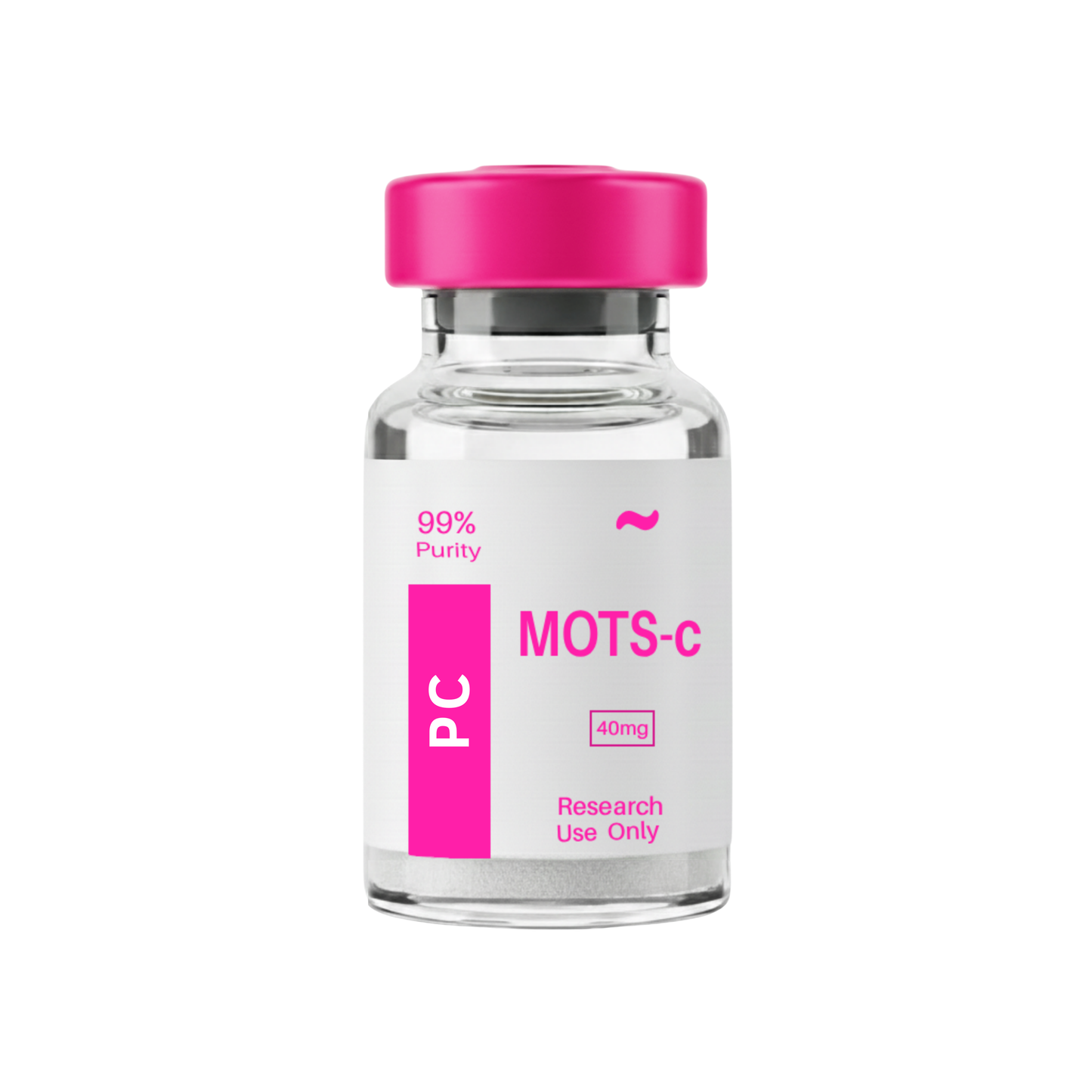
MOTS-c
MOTS-c
This batch of MOTS-c Mitochondrial Peptide has been third party lab tested and verified for quality.
Size: 40mg
Contents: Mitochondria
Form: Powder
Purity: 99.0%
Couldn't load pickup availability
Free Reconstitution Solution automatically added to your cart with each order.
This product is Made, Tested & Shipped From Canada.
Ships Today
Order by 1:00 PM EST
Free Shipping
For 2 or more vials
Verified+

MOTS-c Peptide Description
MOTS-c (mitochondrial open reading frame of the 12S rRNA type-c) is a unique 16-amino acid peptide transcribed from the mitochondrial genome. It is highly valued in research for its roles in achieving metabolic equilibrium, enhancing the cellular response to insulin, and preserving mitochondrial stability, especially under metabolic stress. Scientific data suggests that MOTS-c exerts its powerful regulatory influence primarily via the AMPK signaling pathway and other mechanisms involved in metabolic function and the hallmarks of aging.
MOTS-c Peptide Overview
MOTS-c is classified as a short peptide encoded by the mitochondria, placing it in the family of mitochondrial-derived peptides (MDPs). These peptides are increasingly recognized as potent bioactive signaling molecules that are vital for energy regulation, metabolic control, and communication across organelles. Beyond their initial localization within the mitochondria, current findings confirm that many MDPs, including MOTS-c, are capable of relocating to the cell nucleus and entering the systemic circulation, where they act as circulating hormone-like factors.
MOTS-c, a recent discovery in the MDP field, has been shown to modulate a wide range of biological processes, including metabolism, body weight, exercise capacity, cellular longevity, and bone maintenance. Its presence in both nuclear and circulatory compartments validates its function as an endogenous hormone-like peptide. The impressive biological activity and therapeutic promise of MOTS-c have made it a major subject of research over the past few years.
MOTS-c Peptide Research
Muscle Metabolism
- Studies using mouse models demonstrate that MOTS-c can effectively combat age-related insulin resistance in skeletal muscle, thereby promoting better glucose uptake.
- This is facilitated by activating the AMPK pathway, which sensitizes skeletal muscle and increases the expression of glucose transporter molecules on the cell surface.
- A key finding is that this mechanism operates independently of the insulin receptor, providing an important alternative pathway for glucose uptake when typical insulin signaling is impaired.
- The resulting effects include improved physical endurance, support for muscle tissue growth, and a measurable reduction in muscle insulin resistance.
Fat Metabolism
- Animal research suggests a correlation between reduced estrogen levels, increased fat accumulation, and impaired adipose tissue function, all of which are precursors to insulin resistance and diabetes.
- Conversely, administration of MOTS-c in mice has been shown to promote brown fat activity (thermogenesis) and reduce the amount of white fat deposition. The peptide also appears to guard against the inflammation and dysfunction of adipose tissue that are characteristic of pre-diabetic states.
- A primary mechanism for MOTS-c's effect on fat metabolism is the activation of the AMPK signaling pathway. This pathway is triggered under conditions of low energy, and its activation increases the cellular uptake and utilization (oxidation) of both glucose and fatty acids for energy production.
- MOTS-c mediates these metabolic benefits by specifically targeting the methionine–folate cycle, leading to elevated AICAR levels and subsequent AMPK activation.
- Furthermore, contemporary research reveals MOTS-c's capability to shuttle out of the mitochondria and into the cell nucleus, where it can influence nuclear gene expression. In response to metabolic challenges, MOTS-c has been observed to regulate genes related to energy adaptation, glucose restriction, and antioxidant defense.
Metabolic Area
Key Action of MOTS-c
Physiological Outcome
Metabolic Regulation
AMPK Pathway Activation
Enhanced energy efficiency, Improved fuel utilization
Adipose Tissue
Suppresses Sphingolipid/Dicarboxylate Pathways
Reduced fat storage, Lower inflammation
Skeletal Muscle
Insulin-Independent Glucose Uptake
Improved glucose homeostasis, Better muscle function
Bone Health
Promotes Type I Collagen Synthesis
Increased bone density and structural quality
Experimental data from obese mice establishes MOTS-c as a key modulator of sphingolipid, monoacylglycerol, and dicarboxylate metabolism. By suppressing these lipid biosynthesis pathways while stimulating beta-oxidation (fat breakdown), MOTS-c helps reduce systemic fat accumulation, an action largely mediated by its nuclear signaling.- The current research surrounding MOTS-c offers a new framework for understanding the link between fat storage and insulin resistance, suggesting exciting new therapeutic avenues for managing obesity and diabetes.
- A proposed mechanism is that impaired mitochondrial fat metabolism hinders fatty acid oxidation, resulting in elevated circulating levels of lipids. To clear this excess fat, the body increases insulin secretion. This long-term adaptive response eventually leads to chronic fat storage and sustained high insulin levels, culminating in insulin resistance.
Insulin Sensitivity
- Analysis of MOTS-c concentrations in humans suggests that the peptide's correlation with insulin sensitivity is more evident in lean individuals than in insulin-resistant subjects.
- This finding leads researchers to hypothesize that MOTS-c may play a more significant role in the initial stages of insulin resistance development rather than in the established, long-term dysfunction.
- Consequently, monitoring MOTS-c levels is proposed as a potential early biomarker for identifying individuals at risk of developing prediabetes or insulin resistance.
- Experimental supplementation with MOTS-c in these early stages may offer a method to delay the onset of insulin resistance and diabetes. While animal studies have yielded very encouraging results, comprehensive research is still needed to fully elucidate the complex mechanisms by which MOTS-c influences insulin function.
Osteoporosis
- MOTS-c plays a role in supporting bone health by promoting the synthesis of type I collagen within osteoblasts (bone-forming cells).
- In vitro evidence from osteoblast cell lines shows that MOTS-c regulates the TGF-beta/SMAD signaling pathway, a critical cascade for osteoblast survival, proliferation, and function.
- By boosting osteoblast activity, MOTS-c enhances collagen production, which in turn leads to improvements in bone density, strength, and structural integrity.
Article Author
This review was drafted, collated, and structured by Dr. Changhan Lee, Ph.D., a recognized authority in mitochondrial biology and peptide signaling.
Dr. Lee is best known for his landmark discovery of MOTS-c (Mitochondrial Open Reading Frame of the 12S rRNA type-c) and his focused investigations into the function of mitochondrial-derived peptides (MDPs). His research at the University of Southern California Leonard Davis School of Gerontology has been instrumental in advancing the scientific understanding of how mitochondrial peptides regulate core biological processes, including metabolism, insulin response, and the molecular mechanisms of aging.
Scientific Journal Author
The foundational scientific studies referenced in this review were conducted by Dr. Changhan Lee, Dr. Pinchas Cohen, and their team of collaborators — including Dr. Kyung Hoon Kim, Dr. Hao Lu, Dr. Jiao Jiao, and Dr. Y. Lin.
Collectively, these scientists have made indispensable contributions to the initial identification, characterization, and functional understanding of MOTS-c and related mitochondrial-derived peptides. Their research, spanning leading institutions such as the University of Southern California, Kyungpook National University, and Peking University, has been published in high-impact scientific journals, including Cell Metabolism, Nature Communications, and the Journal of Endocrinology.
Reference Citations
- Lee, C. et al. (2015). The mitochondrial-derived peptide MOTS-c promotes metabolic homeostasis and reduces obesity and insulin re- sistance. Cell Metabolism, 21(3), 443-454.
- Reynolds, J. et al. (2020). Mitochondrial-derived peptides: new frontiers in metabolic signaling. Trends in Endocrinology & Metabolism, 31(2), 101-112.
- Kim, K.H. et al. (2018). MOTS-c suppresses mitophagy in the liver. Nature Communications, 9, 1614.
- Lu, H. et al. (2019). Mitochondrial-derived peptide MOTS-c prevents muscle atrophy by activating AMPK and SIRT1. Aging, 11(15), 4686- 4700.
- Jiao, J. et al. (2021). MOTS-c alleviates insulin resistance in skeletal muscle through enhanced mitochondrial biogenesis. Journal of Endocrinology, 249(3), 243-256.
- Cobb, L. J. et al. (2016). Mitochondrial peptide humanin regulates lifespan and insulin sensitivity. Science Translational Medicine, 8(326), 326ra21.
- Zempo, H. et al. (2016). Mitochondrial-derived peptide MOTS-c: a new player in exercise-induced metabolic improvements. Sports Medicine, 46(7), 965-973.
- Lu, Y. et al. (2021). The role of MOTS-c in muscle aging and sarcopenia. Frontiers in Physiology, 12, 710534.
- Lin, Y. et al. (2022). MOTS-c increases thermogenic activity in brown adipose tissue. Biochemical and Biophysical Research Communications, 590, 101-107.
- Kim, S.J. et al. (2021). Protective effect of MOTS-c on mitochondrial dysfunction in aged mice. GeroScience, 43, 897-909.
- Katsyuba, E. et al. (2020). NAD+ homeostasis in health and disease. Nature Metabolism, 2, 9-31.
- Chen, Y. et al. (2020). MOTS-c ameliorates cognitive decline in a mouse model of aging. Journal of Molecular Neuroscience, 70(3), 358-368.
ALL ARTICLES AND PRODUCT INFORMATION PROVIDED ON THIS WEBSITE ARE FOR INFORMATIONAL AND EDUCATIONAL PURPOSES ONLY.
The products offered on this website are furnished for in-vitro studies only. In-vitro studies (Latin: in glass) are performed outside of the body. These products are not medicines or drugs and have not been approved by the FDA to prevent, treat or cure any medical condition, ailment or disease. Bodily introduction of any kind into humans or animals is strictly forbidden by law.
Storage
Storage Instructions
- All products are processed via lyophilization (freeze-drying), which guarantees stability during shipment for approximately 3-4 months.
- After reconstitution with bacteriostatic water, the peptides must be kept in a refrigerator to maintain their effectiveness, remaining stable for up to 30 days.
- Lyophilization, also known as cryodesiccation, is a specialized dehydration process. It involves freezing the peptide and subjecting it to low pressure, causing the water to sublime (change directly from a solid to a gas). This yields a stable, white crystalline structure, the lyophilized peptide, which can be safely kept at room temperature until reconstitution with bacteriostatic water.
- For the most extended storage periods, spanning multiple months to years, it is best to keep peptides in a freezer at -80 degree C (-112 degree F). This ultra-low temperature is optimal for maintaining the peptide's structural integrity and ensuring long-term stability.
- Upon receipt, ensure peptides are cool and protected from light. For immediate or short-term experimental needs (days to months), refrigeration below 4 degree C (39 degree F) is sufficient. The lyophilized powder is stable at room temperature for several weeks, acceptable for very brief storage.
Best Practices For Storing Peptides
Proper storage protocols are essential for preserving the accuracy and integrity of laboratory research results. Correct handling minimizes degradation, oxidation, and contamination, maximizing the peptide's effective lifespan.
- Peptides should be stored in a cool, light-protected environment upon arrival.
- Short-term storage (days to months) is appropriate via refrigeration below 4 degree C (39 degree F).
- Long-term preservation (months to years) requires storage in a freezer at -80 degree C (-112 degree F) for optimal stability.
- Minimize freeze-thaw cycles, as repeated temperature shifts accelerate the degradation process.
- Avoid frost-free freezers because the temperature fluctuations during their defrost cycles can compromise peptide stability.
Preventing Oxidation and Moisture Contamination
It is critical to shield peptides from air and moisture, which can both degrade stability.
- Moisture contamination often occurs when a cold vial is exposed to room air. To prevent condensation on the peptide or inside the container, the vial must be allowed to reach room temperature before opening.
- Air exposure must be minimized. The container should be kept closed as much as possible, and promptly resealed after the necessary amount is removed.
- Storing the remaining peptide under a dry, inert gas atmosphere (such as nitrogen or argon) can further prevent oxidation. Peptides containing cysteine (C), methionine (M), or tryptophan (W) residues are particularly sensitive to air oxidation and require meticulous care.
- To ensure long-term stability, avoid repeated thawing and refreezing. The best practice is to divide the total peptide into smaller, single-use aliquots. This prevents repeated exposure to temperature and air.
Storing Peptides In Solution
Peptide solutions have a much shorter shelf life than lyophilized peptides and are more vulnerable to bacterial degradation.
- Peptides containing the residues cysteine (Cys), methionine (Met), tryptophan (Trp), aspartic acid (Asp), glutamine (Gln), or N-terminal glutamic acid (Glu) are known to degrade faster in solution.
- If solution storage is necessary, use sterile buffers with a mildly acidic pH (between 5 and 6).
- Aliquoting the solution is necessary to minimize freeze-thaw cycles.
- Most peptide solutions are stable for up to 30 days when refrigerated at 4 degree C (39 degree F). However, less stable peptides should be frozen when not in immediate use.
Peptide Storage Containers
Storage containers must be clean, clear, durable, and chemically resistant.
- They should be appropriately sized to minimize air headspace.
- High-quality glass vials offer the best combination of clarity, stability, and chemical inertness, though plastic (polystyrene or polypropylene) is also suitable.
- Peptides are often shipped in plastic to reduce breakage. They can be safely transferred between glass and plastic vials depending on the specific storage or experimental requirements.
Peptide Storage Guidelines: General Tips
Follow these essential guidelines to preserve peptide stability and prevent degradation:
- Store peptides in a cold, dry, and dark environment.
- Avoid repeated freeze-thaw cycles.
- Minimize air exposure to reduce the risk of oxidation.
- Protect peptides from light.
- Store in the lyophilized form long term; avoid keeping peptides in solution for extended periods.
- Aliquoting is recommended to minimize unnecessary handling and exposure.
-

HIGHEST QUALITY PEPTIDES
Our products are scientifically formulated and manufactured in cGMP-compliant facilities.
-

FAST DELIVERY
Enjoy fast and reliable 3–5 day shipping.
-

Dedicated Customer Service
Our customer service team is highly knowledgeable in peptide research and its applications. We’re available 24/7 to assist you.
Verified reviews
Tested. Verified. Trusted.
We take a laboratory-first approach to quality. Each batch is made under controlled conditions and verified by an independent lab (HPLC/MS). We only ship batches that test ≥99% purity, and we provide a full COA, including identity, methods, and chromatograms, for your review.
Shop now
See the Process for Yourself
We make our peptides in our own cGMP lab. Watch the video to see how every vial is produced, tested, and handled with care.
Science Behind Our Peptides
A clear explanation of how our peptides work, their benefits, why quality matters for best results, and what you should know.
You may also like
-
SAVE 25%Reconstitution Solution
Regular price $15.00Regular price $15.00 Sale priceUnit price / per$20.0025% -
BPC-157 + TB-500 + GHK-Cu Peptide Blend - Research Grade Peptide Compound
Regular price $139.00Regular price $139.00 Sale priceUnit price / per$181.0023% -
Glow BPC-157 + GHK-CU + TB-500 - Premium Research Peptide
Regular price $139.00Regular price $139.00 Sale priceUnit price / per$181.0023% -
SAVE 25%Tirzepatide
Regular price From $50.00Regular price From $50.00 Sale priceUnit price / per$67.0025% -
Thymosin Alpha-1 - Premium Research Peptide
Regular price From $79.00Regular price From $79.00 Sale priceUnit price / per$104.0024% -
SAVE 23%Tesamorelin
Regular price From $75.00Regular price From $75.00 Sale priceUnit price / per$98.0023% -
SAVE 23%Survodutide
Regular price From $299.00Regular price From $299.00 Sale priceUnit price / per$392.0023% -
SAVE 23%Sterile Water
Regular price From $13.00Regular price From $13.00 Sale priceUnit price / per$17.0023% -
SAVE 23%SLU-PP-332
Regular price From $113.00Regular price From $113.00 Sale priceUnit price / per$148.0023% -
SAVE 25%Sermorelin
Regular price From $63.00Regular price From $63.00 Sale priceUnit price / per$84.0025% -
SAVE 27%Semaglutide
Regular price From $32.00Regular price From $32.00 Sale priceUnit price / per$44.0027% -
SAVE 26%Oxytocin Acetate
Regular price From $38.00Regular price From $38.00 Sale priceUnit price / per$52.0026% -
SAVE 24%LL-37 - Premium Research Peptide
Regular price $85.00Regular price $85.00 Sale priceUnit price / per$112.0024% -
SAVE 23%Lipo-C with B Vitamins
Regular price From $73.00Regular price From $73.00 Sale priceUnit price / per$96.0023% -
SAVE 23%Lemon Bottle 10mg
Regular price From $75.00Regular price From $75.00 Sale priceUnit price / per$98.0023% -
SAVE 23%L-Carnitine
Regular price From $97.00Regular price From $97.00 Sale priceUnit price / per$127.0023% -
KPV Tripeptide - Premium Research Peptide
Regular price From $56.00Regular price From $56.00 Sale priceUnit price / per$74.0024% -
KLOW Blend - GHK-CU + TB-500 + BPC-157 + KPV 10mg
Regular price From $188.00Regular price From $188.00 Sale priceUnit price / per$246.0023% -
SAVE 25%Kisspeptin-10
Regular price From $63.00Regular price From $63.00 Sale priceUnit price / per$85.0025% -
SAVE 25%Ipamorelin
Regular price From $27.00Regular price From $27.00 Sale priceUnit price / per$36.0025% -
SAVE 26%Hyaluronic Acid
Regular price From $25.00Regular price From $25.00 Sale priceUnit price / per$34.0026% -
SAVE 23%HGH Fragment 176-191
Regular price From $87.00Regular price From $87.00 Sale priceUnit price / per$114.0023% -
SAVE 25%HGH 191AA (Somatropin)
Regular price From $50.00Regular price From $50.00 Sale priceUnit price / per$67.0025% -
SAVE 25%Gonadorelin
Regular price $50.00Regular price $50.00 Sale priceUnit price / per$67.0025% -
Glutathione - Premium Research Peptide
Regular price $83.00Regular price $83.00 Sale priceUnit price / per$109.0023% -
Glow BPC-157 + GHK-CU + TB-500 - Premium Research Peptide
Regular price $139.00Regular price $139.00 Sale priceUnit price / per$181.0023% -
SAVE 26%Epitalon (Epithalon)
Regular price From $28.00Regular price From $28.00 Sale priceUnit price / per$38.0026% -
SAVE 25%Dermorphin
Regular price From $50.00Regular price From $50.00 Sale priceUnit price / per$67.0025% -
SAVE 24%CJC-1295 with DAC
Regular price From $69.39Regular price From $69.39 Sale priceUnit price / per$92.0024% -
SAVE 23%CJC-1295 No DAC & Ipamorelin
Regular price From $90.30Regular price From $90.30 Sale priceUnit price / per$118.0023% -
SAVE 23%CJC-1295 (No DAC)
Regular price From $75.00Regular price From $75.00 Sale priceUnit price / per$98.0023%
Every vial we sell comes from a lab that follows current Good Manufacturing Practices (cGMP). That means each step of production is documented and controlled. Before a batch is released, it’s tested by independent third-party labs for purity, identity, and sterility. Certificates of analysis are available so you can see the exact test results.
Yes. The labs we work with use ISO-certified clean rooms where air quality, equipment, and handling procedures are tightly regulated. Staff are trained to pharmaceutical-grade standards. This ensures the peptides are produced in an environment that minimizes contamination risks.
Peptides in lyophilized (freeze-dried) form are stable at room temperature for transport. Once you receive them, refrigeration is recommended to maintain long-term integrity. We package every order securely to prevent damage and ship promptly, so your vials arrive in optimal condition.
We operate under strict in-house protocols that follow current Good Manufacturing Practices (cGMP). That means our team oversees the entire process from sourcing raw amino acids to the final lyophilized vial. Nothing is outsourced or repackaged. This gives us full control over purity, consistency, and sterility, and it’s why we can stand behind every single vial we ship.
Store them in the refrigerator, away from direct light and heat. If you need to keep them longer, some peptides can be stored frozen. Each vial comes with clear handling instructions so you know the proper conditions for stability.
The strongest proof is transparency. For every peptide, we can provide certificates of analysis, manufacturing documentation, and references to the published scientific research behind it. If you ever have questions, we’ll show you the data rather than ask you to take our word for it.
The difference is transparency. Most sites give you a product name and a price. We provide full batch testing, lab documentation, and direct access to certificates of analysis so you don’t have to guess what you’re getting. When you order from us, you know exactly what’s in the vial, where it was made, and how it was verified.